[Case Study] Thermal Management for Humanoid Robots
Thermal Management for Humanoid Robots
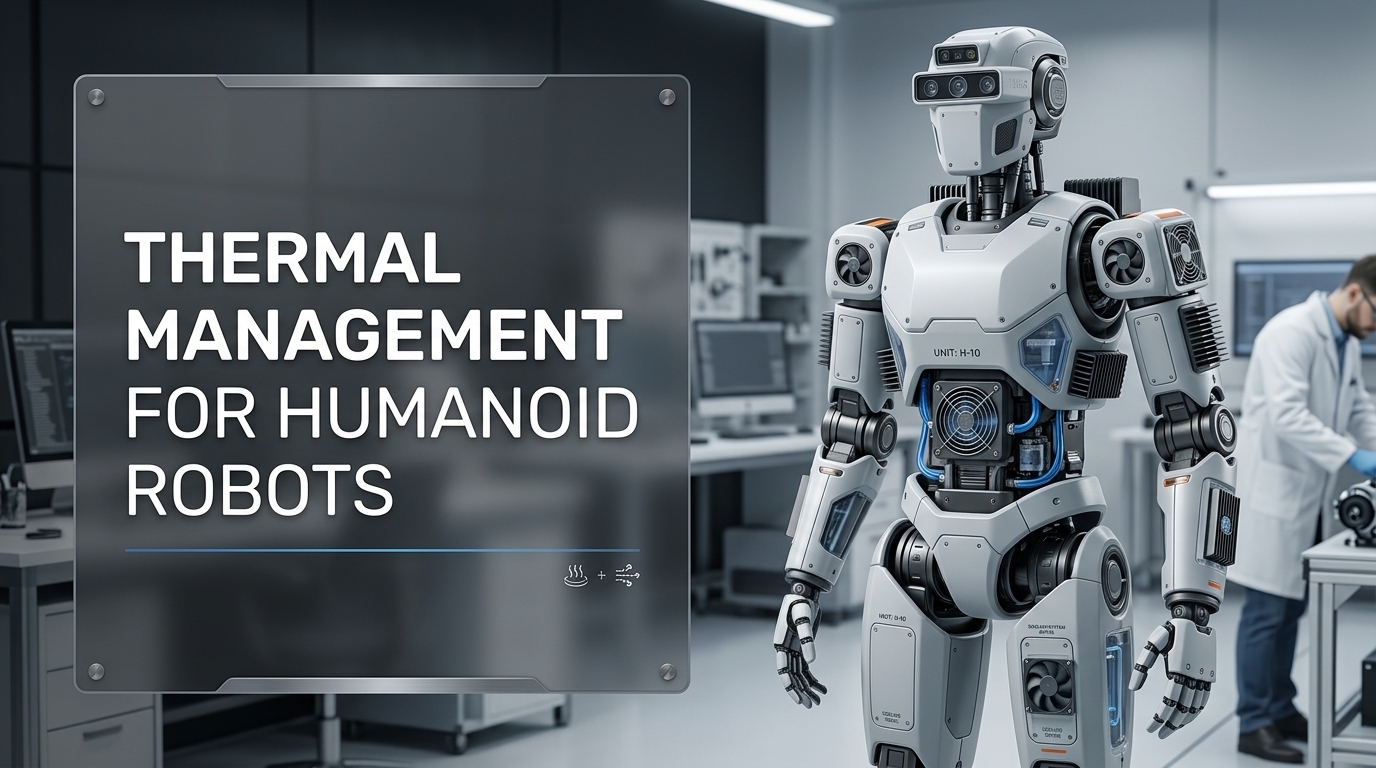
During sustained high-load operation, robot performance depends not only on algorithms and motion control, but also on effective hardware thermal management. Humanoid and other high-performance mobile robots integrate multiple power-dense components, including motors and gearboxes in joint modules, power electronics in drive controllers, processors in AI computing units, and battery and power-management systems.
These components generate heat during long duty cycles and frequent movement. Compact packaging leaves limited space for cooling, increasing the risk of excessive temperatures, performance throttling, protective shutdowns and reduced reliability.
Improving heat transfer and integrating effective cooling structures within the available space are therefore essential to stable, continuous operation.
Why robot thermal management is getting harder
A high-performance robot contains several heat sources with different load profiles. Joint motors and drives may see repeated peaks. Power-electronic modules switch high current in a small volume. On-board AI hardware can sustain concentrated compute loads, while the battery pack must remain within a controlled temperature range.
If heat is not removed quickly enough, component temperatures rise. The practical consequences may include motor or processor derating, accelerated insulation and cell ageing, changes in lubricant behaviour, and shorter component life. The challenge is not simply to add more surface area; the cooling path must fit around moving joints, structural loads, cables, sensors and service access.
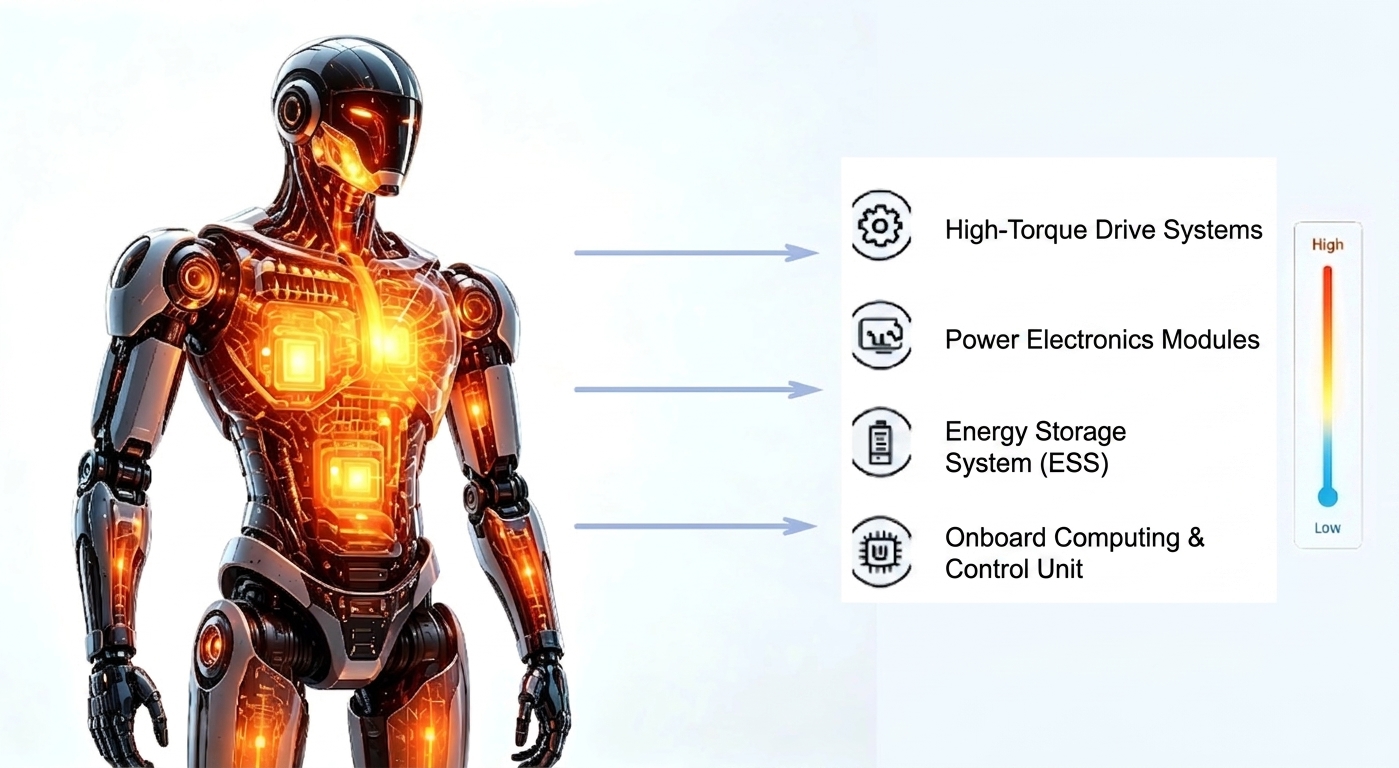
Figure 1. Typical heat sources include high-torque actuators, power electronics, the battery pack and compute hardware.
Four cooling approaches—and their limits
Robots rarely rely on one cooling method throughout the machine. A practical architecture may combine an housing, a heat pipe, local forced air and a liquid loop. The correct mix depends on heat load, duty cycle, orientation, mass, noise, contamination risk and maintenance requirements.
|
Approach |
Best suited to |
Main benefit |
Design limit |
|
Natural convection |
Low-power or intermittent loads |
Simple, quiet and no moving parts |
Limited heat rejection; sensitive to enclosure and orientation |
|
Forced air |
Controllers and ventilated enclosures |
Mature and relatively low cost |
Consumes space; adds noise, dust exposure and a fan-life constraint |
|
Heat pipe / vapour chamber |
Moving a local hot spot to a remote sink |
High effective in-plane or axial conductance |
Shape, wick design, orientation and joining constrain integration |
|
Liquid cooling |
High heat flux, long duty cycles and compact packaging |
Carries heat out of a confined region and can improve temperature uniformity |
Adds pumps, seals, coolant management, pressure drop and leak-control requirements |
What changes when liquid cooling enters the design
Liquid cooling can place the coolant close to the heat source, but it turns the cold plate or cooling jacket into a pressure-containing flow component. Channel layout must balance heat-transfer area, flow distribution and pressure drop. Thin walls shorten the conduction path, while adequate wall thickness and local support are still needed for pressure, vibration and handling.
For a simple wall, conduction resistance follows Rcond = t/(kA), where t is conduction length, k is thermal conductivity and A is heat-transfer area. The relation explains why high-conductivity materials and short thermal paths matter, but it does not capture convection, contact resistance or flow maldistribution. Those terms still have to be evaluated in the full thermal model.
Conventional manufacturing remains suitable for many cold plates
Machined channels closed by brazing, diffusion bonding or welding are established routes, particularly for planar designs and high-volume programmes. Their limits appear when channels must follow a curved envelope, split repeatedly, change cross-section or merge with mounting and manifold features. Additional joints can also add process steps and inspection points.
Where metal additive manufacturing earns its place
LPBF can build enclosed passages, manifolds and external geometry in one part. This can reduce part count and allow channels to follow the available space. The benefit is strongest when integration or packaging solves a defined system problem. If the part is a simple plate with straight milled channels, conventional machining may remain the more economical route.
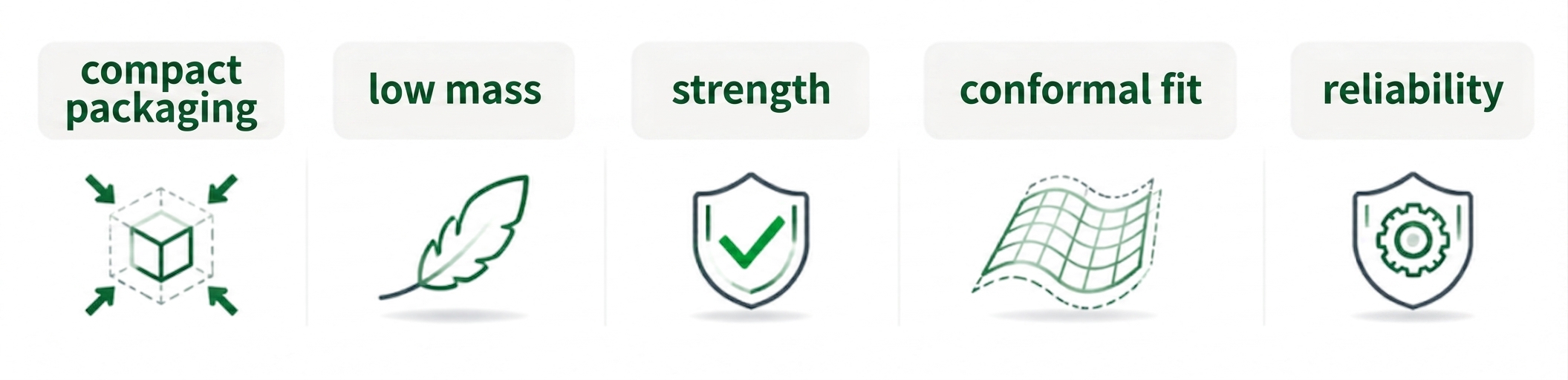
Figure 2. Typical robot cooling requirements: compact packaging, low mass, strength, conformal fit and reliability.
Three robot applications worth evaluating
1. Joint actuators and motor-drive modules
A conformal cooling jacket can follow a motor, stator region or drive enclosure more closely than a flat plate. Printed manifolds can distribute coolant around an irregular joint housing and reduce the number of fittings. The design still has to account for moving mass, structural load paths, electrical isolation, hose routing and service access. Pure copper is useful where heat spreading justifies its mass; aluminium or a hybrid architecture may be better where weight dominates.
2. On-board AI compute modules
Compact processors can create a concentrated heat source near sensors, communication hardware and power electronics. A copper cold plate can shorten the path from the package interface to the coolant and can integrate small passages or manifolds into a thin volume. Thermal resistance must be evaluated together with contact flatness, coolant temperature, allowable pressure drop, pump power and leak detection.
3. Battery and power-management systems
Battery packs and power converters benefit from controlled temperature distribution rather than maximum local heat removal alone. Printed cold plates or manifolds can route flow around cells, busbars and structural features. Material choice must also consider mass, corrosion, electrical isolation and coolant compatibility; pure copper is not the default answer for every battery assembly.
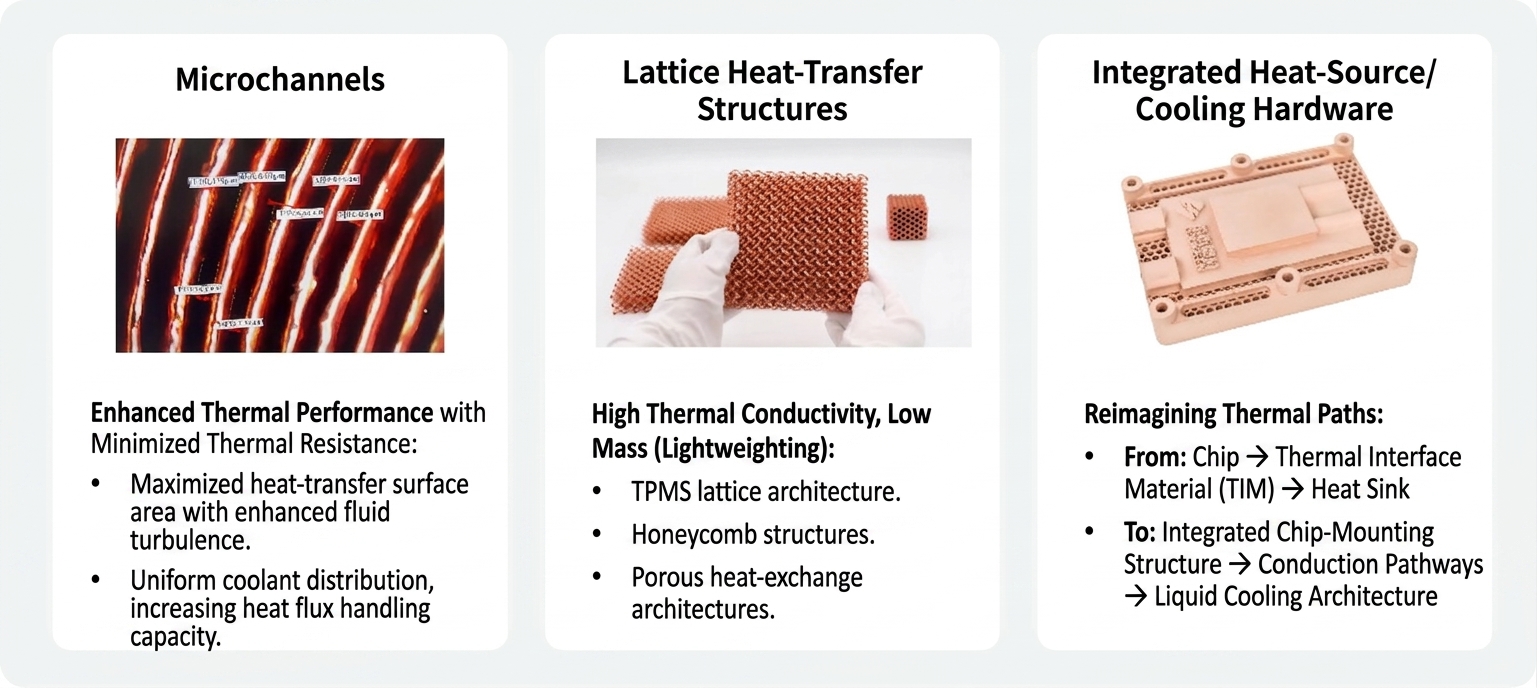
Figure 3. Three AM-enabled design routes e: microchannels, lattice heat-transfer structures and integrated heat-source/cooling hardware.
Manufacturing and verification should be planned together
A ready-to-use cooling part normally needs more than printing. Build orientation and support strategy affect internal passages and machining access. Post-processing may include stress relief, support removal, CNC finishing of sealing and mounting faces, deburring, internal cleaning and a project-specific surface treatment.
Quality assurance should match the failure modes. Dimensional inspection verifies interfaces; CT can examine selected hidden features; flow and pressure-drop tests check the hydraulic design; proof-pressure and leak tests address containment; and a thermal test confirms the complete heat path under defined boundary conditions. Not every part needs every test, but the inspection plan should be agreed before production.
Conclusion
Humanoid robot cooling is a system problem. Passive cooling, forced air and heat pipes remain useful where loads and packaging allow them. Liquid cooling becomes more relevant as heat flux and duty cycle rise, but it brings hydraulic, sealing and validation requirements.
Green-laser copper LPBF is most useful when a robot needs a compact thermal component with conformal passages, integrated manifolds or a shorter heat path that conventional fabrication cannot deliver economically. The decision should begin with the thermal and hydraulic requirements, followed by material choice, manufacturability and a defined test plan.
Expore our thermal management solutions:
https://www.addireennow.com/en/industries/advanced-thermal-management/c44da.html
Upload your CAD file for evaluating:
https://www.addireennow.com/en/quote