[Case Study] Green-Laser LPBF for Pure Copper Induction Coils
Green-Laser LPBF for Pure Copper Induction Coils
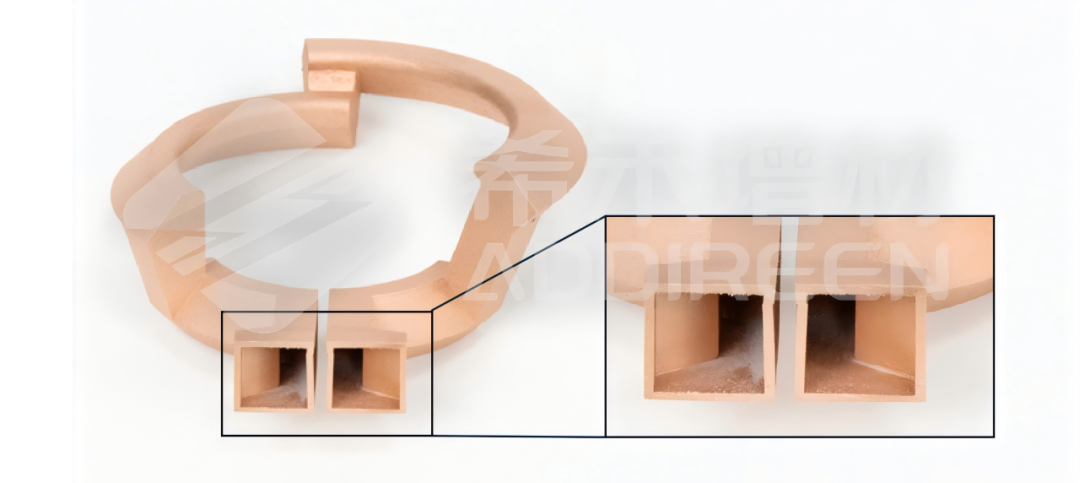
Figure 1. Pure-copper induction-coil with enlarged views of internal cooling passages.
High-frequency induction coils are used in hardening, heat treatment, brazing, melting and other localized heating processes. Their performance depends on more than copper conductivity. Coil geometry, distance to the workpiece, current path, cooling layout and manufacturing quality all affect heating behavior and service reliability.
Many coils are still made from bent copper tubing joined by brazing. That route remains practical for standard geometries, but it can become restrictive when a coil must follow a complex part profile, integrate internal cooling or be revised repeatedly during development.
Why Conventional Coil Construction Can Become a Design Constraint
Jointed construction requires additional control
A conventional water-cooled coil is often assembled from bent copper tubes, fittings and brazed joints. Each joint introduces an interface that must be evaluated for the intended cooling medium, pressure and thermal cycle. For coils with multiple bends, branches or compact interfaces, the number of joints can increase quickly.
Round tube geometry is not always the preferred electromagnetic geometry
Bent tubing naturally favors circular sections. In some applications, a rectangular, D-shaped, tapered or variable cross-section may better suit the available space, local current path or target heating pattern. These shapes are difficult to produce through tube bending alone.
Coil-to-workpiece spacing matters
Induction heating is sensitive to coil position, turn spacing and the gap between the coil and the workpiece. Coil layout, current direction and coil-to-workpiece distance as key variables in temperature distribution and heating uniformity. For complex parts, bending a tube close to a freeform surface can be difficult to control consistently.
Development can involve several manual steps
Complex coils may require repeated bending, fitting, brazing and leak testing before they can be evaluated. When the geometry changes often, these steps can slow the development loop.
Why Green Lasers Matter for Pure Copper LPBF
Pure copper combines high thermal and electrical conductivity with challenging laser-processing behavior. Its high reflectivity and rapid heat conduction can make conventional near-infrared LPBF processing difficult to stabilize.
A 532 nm green laser interacts with copper differently from near-infrared laser. Stronger optical couples at green wavelengths, expanding the available processing window for pure copper. The final result still depends on powder condition, spot size, layer thickness, scan strategy, part geometry and post-processing.
In one green-laser LPBF study, optimized process parameters produced pure-copper with up to 99.9% relative density and electrical conductivity of up to 101% IACS. It shows why green-laser LPBF is relevant when engineers need to combine pure copper with fine features or integrated internal passages.
Three Design Opportunities for 3D-Printed Induction Coils
1. Cross-sections designed for the application
Green-laser LPBF is not limited to bent round tubing. It can produce rectangular, trapezoidal, D-shaped and tapered coil sections where these geometries are justified by electromagnetic, thermal or packaging requirements. The objective is not complexity for its own sake: each section should be evaluated against current distribution, local heat generation, cooling demand, clearance and manufacturability.
2. Conformal coil geometry around the workpiece
A printed induction coil can follow a complex workpiece profile more closely than a standard bent tube. This can help engineers define a more consistent coil-to-part clearance across curved, tapered or asymmetric surfaces. The required gap must still account for part loading, thermal expansion, electrical insulation, tolerances and short-circuit protection.
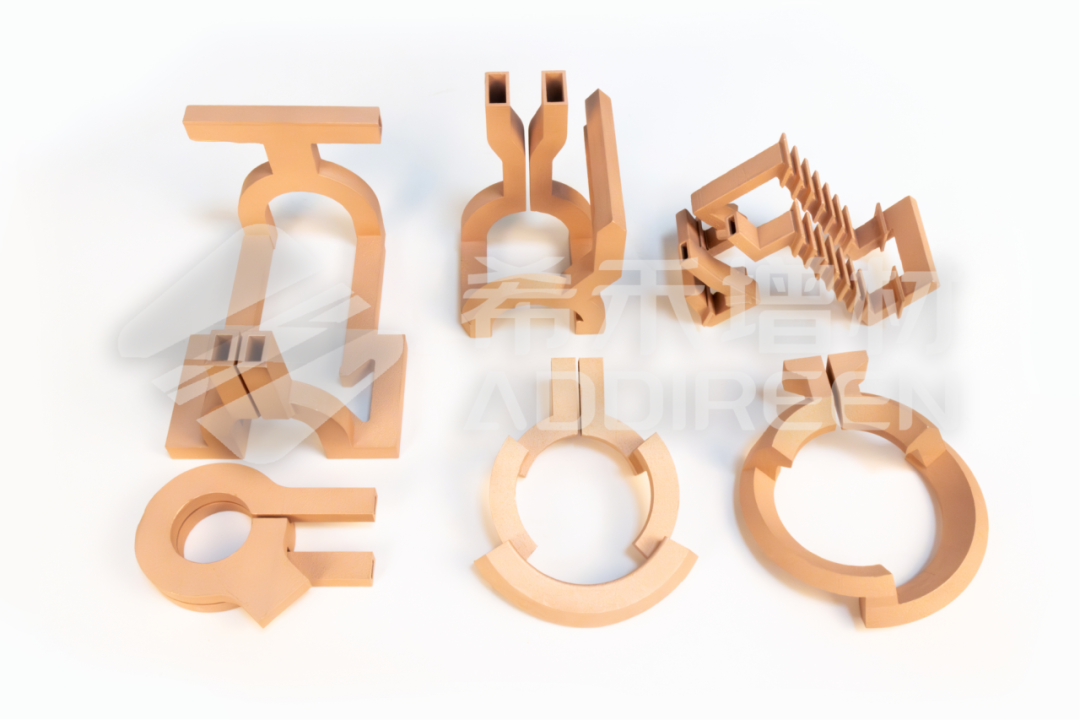
Figure 2. Printed pure-copper coil geometries. The suitable form depends on the workpiece profile, defined clearance and cooling requirements.
3. Integrated internal cooling channels
LPBF can integrate cooling passages inside the coil body rather than relying only on separate bent tubes. This creates opportunities to position coolant paths near local heat-generating regions and to reduce the number of brazed interfaces. Internal channel design must also address powder removal, internal cleanliness, coolant flow rate, allowable pressure drop, leak-tightness and the requirements for fittings and sealing surfaces.
Properties for Green-Laser Printed Pure Copper
|
Property |
Result |
|
Relative density |
Up to 99.9% |
|
Thermal conductivity |
Up to 400 W/(m·K) |
|
Electrical conductivity |
Up to 101% IACS |
Where Pure Copper Printed Induction Coils May Fit
Green-laser LPBF is most relevant where coil geometry, cooling integration or development speed is difficult to achieve with standard bent-and-brazed construction. Typical areas for evaluation include:
- Complex-profile induction hardening coils
- Brazing and localized heating tools
- New-energy and electric-drive manufacturing equipment
- Compact coils with integrated cooling and mounting features
The suitable manufacturing route should be selected case by case. For standard coil geometries and stable high-volume designs, conventional fabrication may remain appropriate. For complex, integrated or frequently revised designs, green-laser pure-copper LPBF offers an additional engineering option.
Explore the Next Step
Have a complex pure-copper induction coil to evaluate?
Submit your CAD model and operating requirements for a manufacturing review covering material, LPBF, post-processing and inspection scope.
Explore induction heating applications: www.addireen.com/en/industries/induction-heating
Upload CAD for a Quote: www.addireennow.com/en