[Case Study] 424 Pure-Copper Optical Transceiver Cold Plates on One Build Plate
424 Pure-Copper Optical Transceiver Cold Plates on One Build Plate
Addireen recently completed a recorded production build of 424 pure-copper cooling components for optical transceivers on an XH-M350G-2HR green-laser metal additive manufacturing system. Each part measured approximately 24×8×70 mm. The build used a dense full-plate layout and included fine fin structures for compact optical-module cooling.
The purpose of the test was straightforward: to assess how the machine performs when copper parts are arranged for batch production rather than printed as isolated samples.
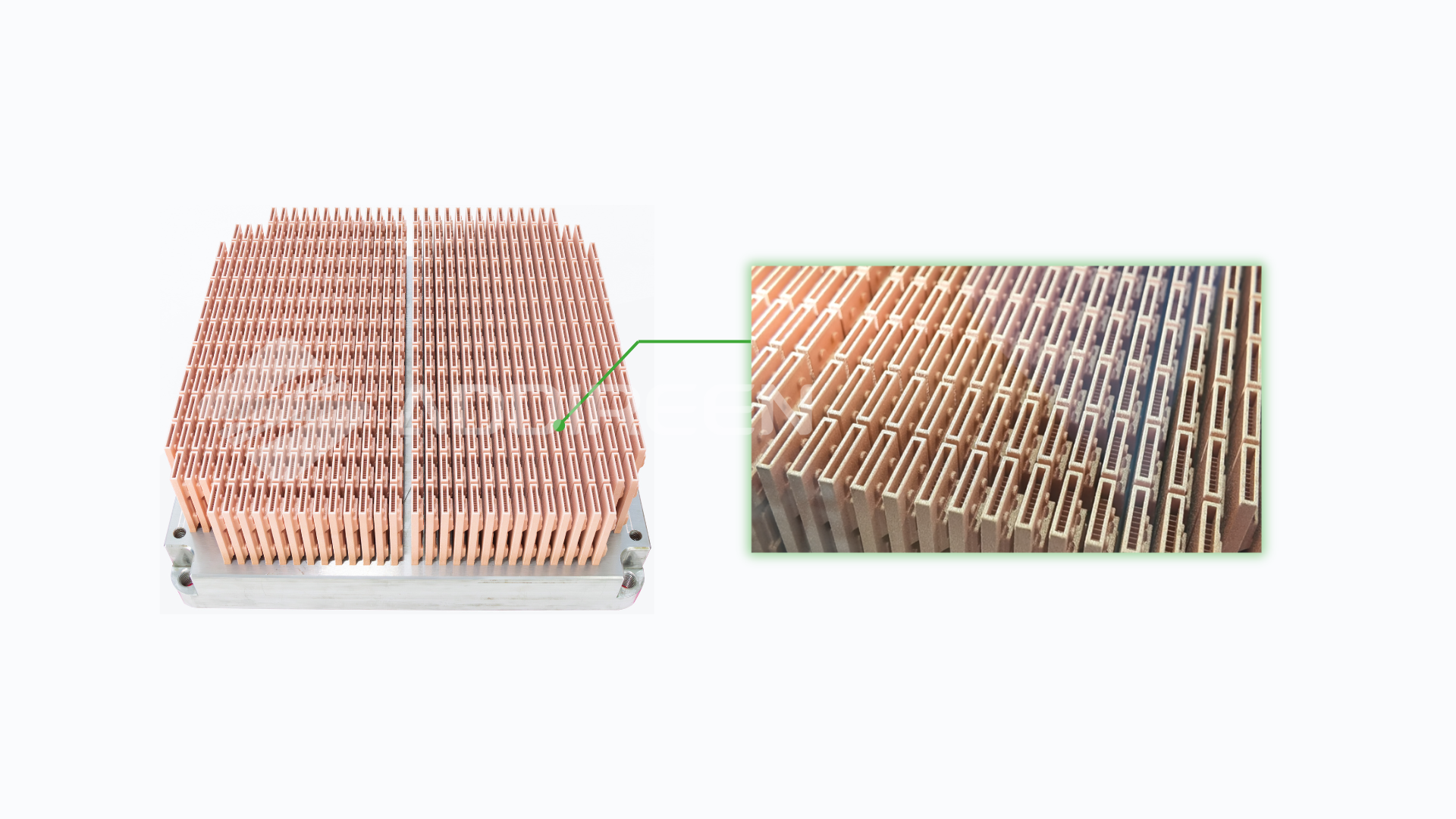
Full-build-plate build containing 424 pure-copper optical-transceiver heat sinks.
The production build
| Item | Recorded information |
| System | Addireen XHM350G2HR |
| Material | Pure copper |
| Component | Optical-transceiver cooling component |
| Approximate part size | 24×8×70 mm |
| Quantity | 424 parts in one build |
| Layout | High-density full-build-plate arrangement |
| Relative density | Up to 99.9% under the evaluated conditions |
A build plate with hundreds of components places demands on the entire process. The laser is only one part of the cycle. Powder recoating, chamber preparation, gas control and machine stability all influence how efficiently the job can run and how consistent the parts are across the plate.
Improving Production Cycle Efficiency
The XH-M350G-2HR was updated in several parts of the production cycle.
First, it uses bidirectional variable-speed recoating. In Addireenʼs internal comparison, this increased recoating efficiency by 48%. For high-part-count builds, a shorter and more consistent recoating step can reduce the accumulated time between laser-exposure cycles.
Second, the machine supports layer thicknesses from 20 to 120 μm. Addireen recorded a build-efficiency increase of more than 50% in selected higher power, larger-layer-thickness process settings. The usable layer thickness still depends on the part geometry, required feature size, density target and surface requirements.
Third, the chamber purging logic and sealing were updated. Internal testing recorded a 63% improvement in purging efficiency. This is relevant before a long copper build, where a controlled chamber atmosphere needs to be established before printing begins.
These figures are internal comparison results, not fixed output values for every part. Actual cycle time will vary with layout density, layer count, scan strategy, powder condition and acceptance criteria.
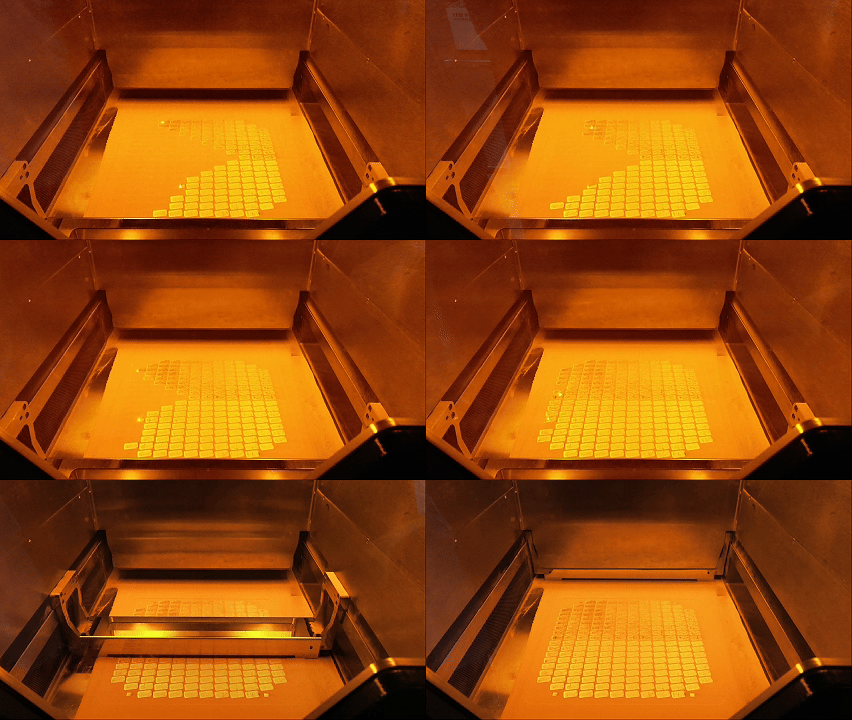
Bidirectional variable-speed recoating is used to reduce non-exposure time between layers.
Green-laser LPBF for compact copper cooling structures
The XH-M350G-2HR uses a 532 nm green laser source developed for copper processing. Green-laser LPBF is particularly relevant for pure-copper 3D printing because it supports stable energy coupling to a material that is highly reflective at more conventional laser wavelengths.
For optical-transceiver cooling, the geometry often has to fit a constrained envelope while still providing useful heat-transfer area. Fine fins, thin walls and closely spaced thermal features can help, but they also make manufacturing more demanding.
Metal AM gives engineers a way to produce these features as one integrated copper part. The design still needs to account for powder removal, build orientation, post-processing access, dimensional tolerance and the intended cooling conditions.
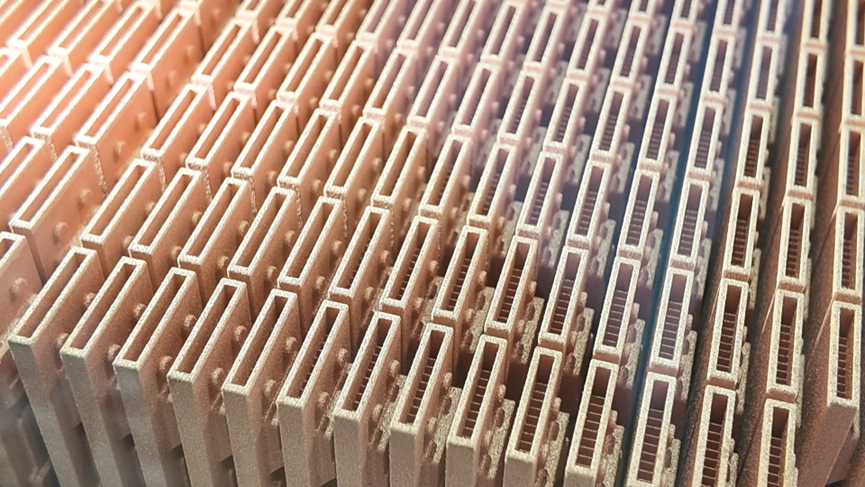
Fine fin structures can be integrated into pure-copper heat sinks through green-laser LPBF.
Looking beyond a single part
The 424-part build was designed to assess more than part count. A dense layout creates a practical test of the motion system, powder deposition, optics and chamber airflow over the entire plate.
The XH-M350G-2HR combines updates to motion control, optical stability and airflow management. The aim is to keep the conditions for each component as consistent as possible throughout the build.
The highest reported relative density for the evaluated pure-copper parts was 99.9%. That figure should be considered alongside the test method, part geometry and process parameters. It is a reference point for the recorded build, not a blanket specification for every copper component.
A production reference for optical-module cooling
Optical modules need cooling hardware that fits limited space and can be produced repeatedly. Pure copper remains attractive because of its thermal conductivity, while metal 3D printing can support integrated fins, internal passages and other thermal features that are difficult to machine or assemble.
This full-build-plate test provides one production reference for pure-copper optical-transceiver cooling components. It shows what should be evaluated when moving from a prototype to a denser production layout: cycle time, recoating, chamber conditions, build consistency and part-level verification.
For a specific project, the next step is to review the CAD model, target material, expected quantity and inspection requirements against the actual manufacturing route.
Explore the XH-M350G-2HR
https://www.addireen.com/en/metal-3d-printers/industrial-green-laser-printer-350
Request a manufacturing quotation:
https://www.addireennow.com/en/quote