[Blog] 3D Printed Cold Plate: From Fine TPMS Features to Batch Production
1. TPMS Heat Exchanger Design for Advanced Liquid Cold Plates
Ø Product-Driven Design for Different Thermal Requirements
Liquid cold plate design should be driven by actual operating conditions and application-specific thermal requirements.In a recent liquid cold plate development project, Addireen explored a zoned, application-adapted TPMS design approach, integrating multiple Triply Periodic Minimal Surface (TPMS) geometries within a single component. Structural dimensions were varied along the fluid flow direction to adapt the internal architecture to different regional requirements.
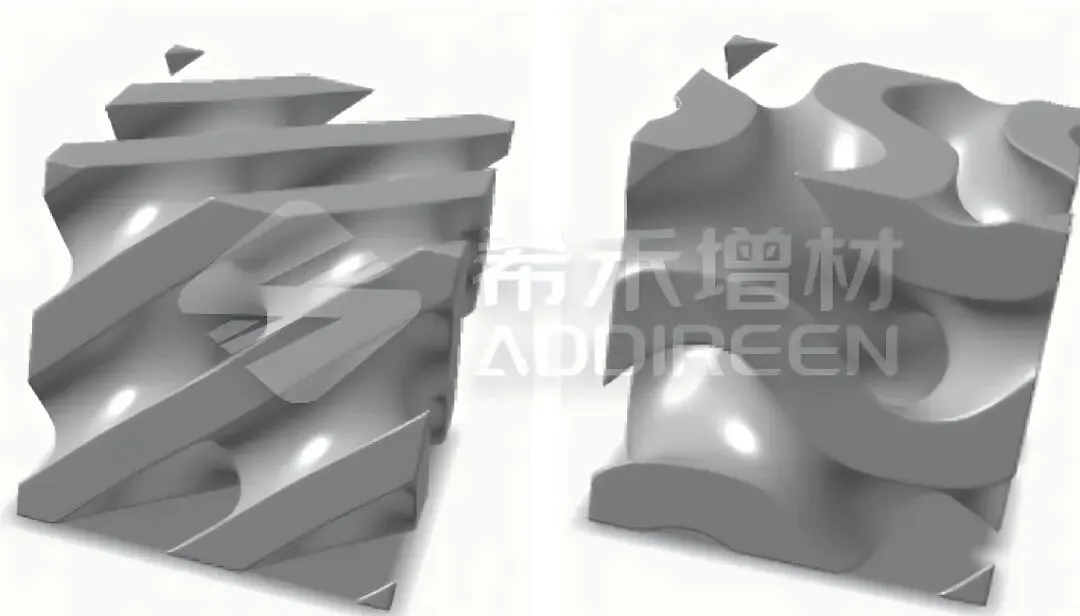
TPMS structures create continuous, interconnected three-dimensional flow channels within a limited design space, increasing the available heat transfer surface area. Their continuous, curved geometries also promote fluid turbulence and enhance thermal exchange between fluid and structural surfaces.
Ø Key Design Features of the TPMS Liquid Cold Plate
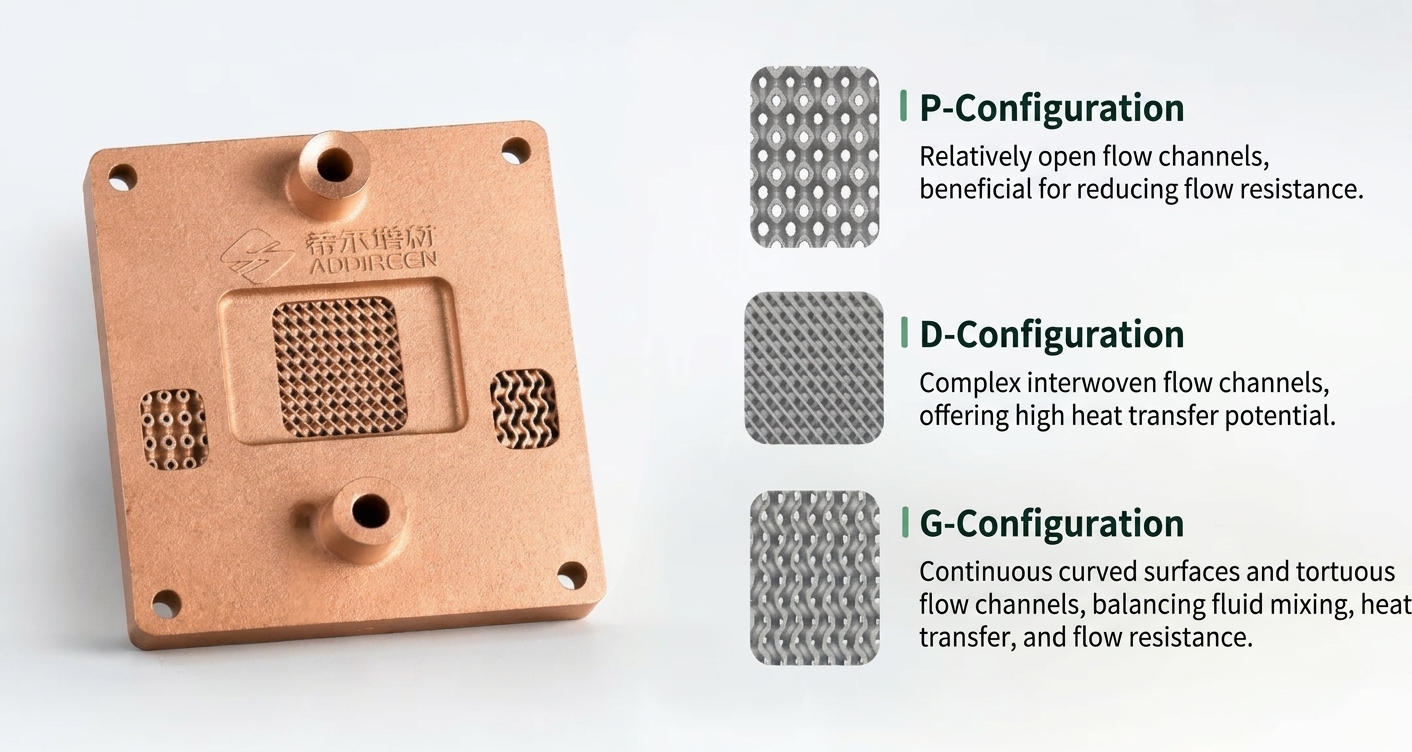
Multiple TPMS Geometries
Multiple TPMS configurations are integrated into different regions of a single liquid cold plate to accommodate varying flow channel requirements and localized heat transfer demands.
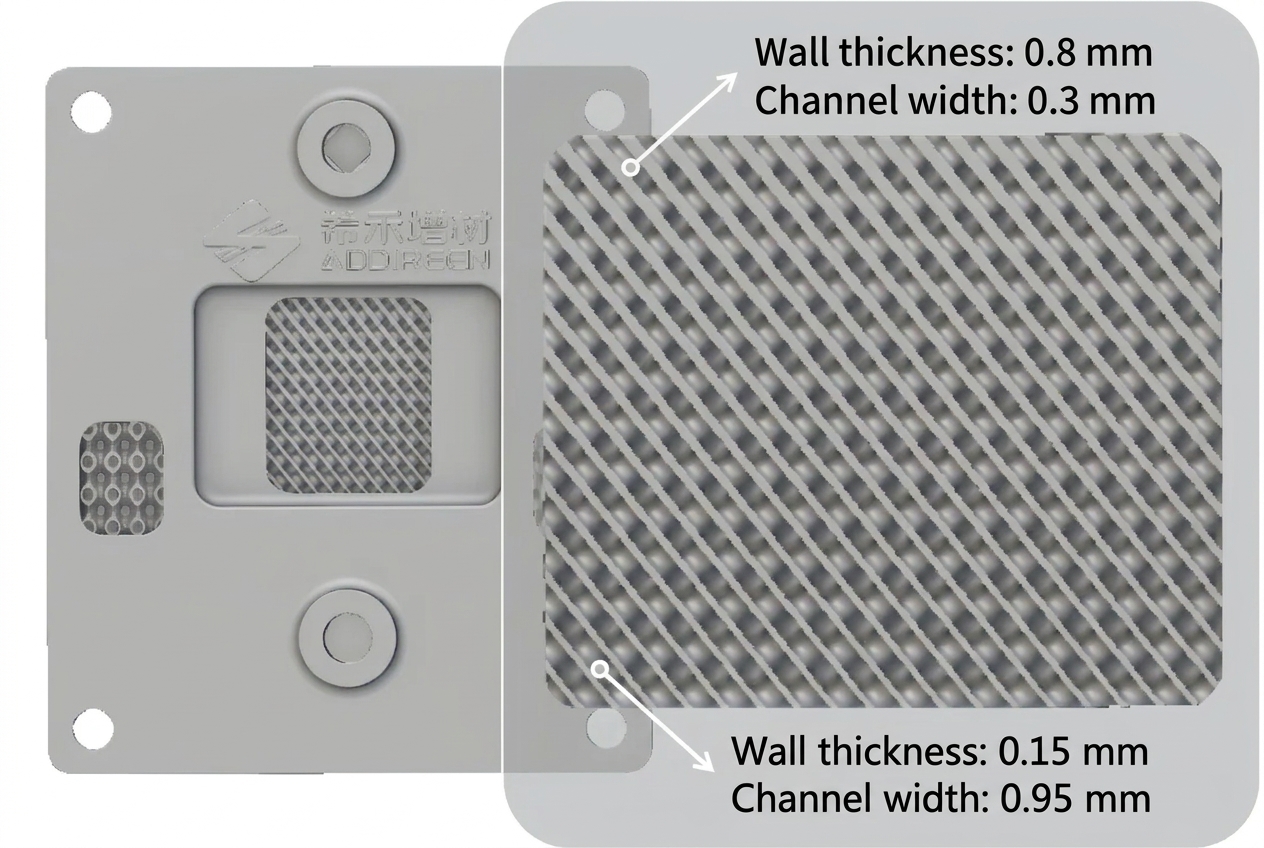
Variable-Scale Flow Channels and Region-Specific Wall Thickness
TPMS feature dimensions vary along the fluid flow path, while wall thickness is optimized for the structural and manufacturing requirements of each region.
Monolithic Integration of Complex Internal Channels
Different internal channel configurations are integrated into a single component, reducing the need to manufacture complex internal structures as separate parts and subsequently assemble them.
These design requirements call for the TPMS geometries, dimensional variations, wall thicknesses, and overall component architecture to be evaluated as an integrated system. They also introduce manufacturing challenges, particularly in maintaining build stability, thin-wall quality, and internal structural integrity.
To address these challenges, Addireen conducted Design for Additive Manufacturing (DfAM) assessments, process development, and prototype validation to evaluate the feasibility of the proposed structural design.
2. Manufacturing Fine Features with Green Laser Metal PBF
Ø Manufacturing Challenges of Complex TPMS Structures
Integrating TPMS flow channels, variable-wall-thickness zones, and multi-scale features within a single liquid cold plate places higher demands on build stability, fine-feature formation, thin-wall quality, and internal structural integrity.
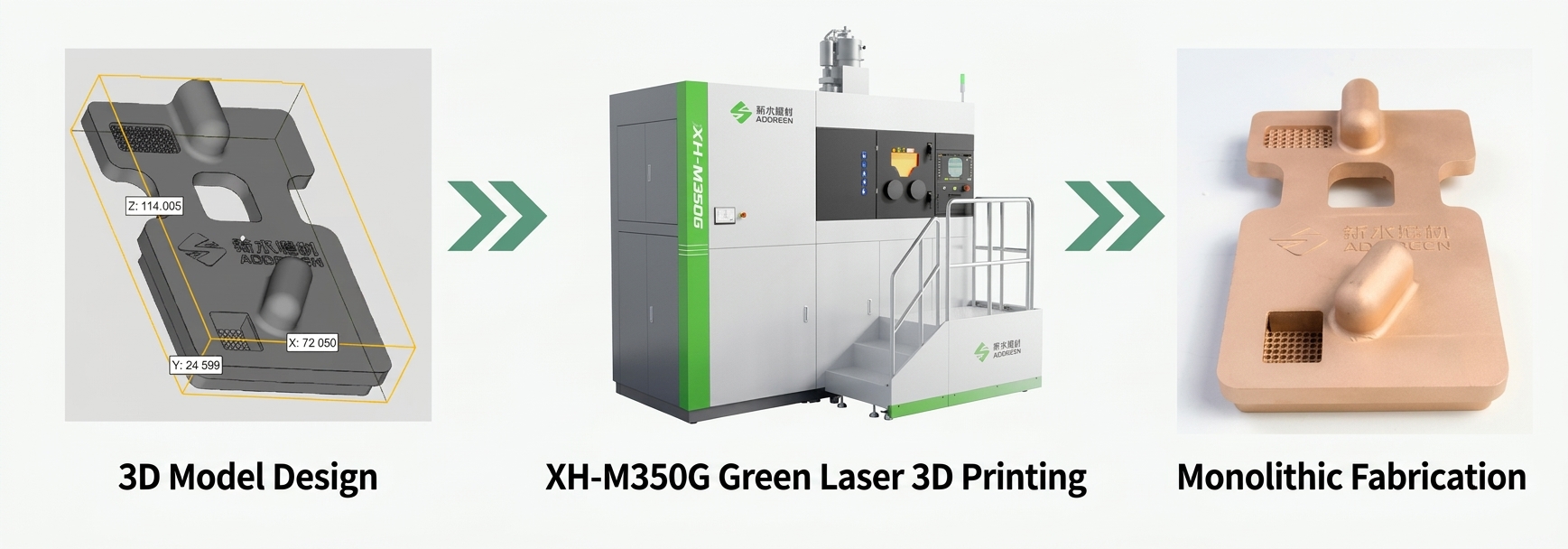
Green Laser Powder Bed Fusion (Green Laser PBF) builds metal components layer by layer based on 3D digital models. By enabling the fabrication of complex internal geometries, this process provides greater design freedom and helps overcome certain geometric limitations associated with conventional machining and multi-part assembly.
For 3D printed heat exchanger designs, including liquid cold plates with complex internal architectures, Green Laser PBF enables different channel configurations and dimensional parameters to be integrated into a single metal component, reducing reliance on separately manufactured parts and subsequent joining operations.
- DfAM and Manufacturing Process Development
Addireen conducts manufacturability assessments and printing process development tailored to the structural characteristics of each cold plate. TPMS geometries, variable-scale flow channels, and thin-wall regions are incorporated into the overall manufacturing plan.
Through complex structural design and process development, Addireen translates product designs into executable manufacturing workflows.
3. From Prototype Validation to Metal 3D Printing Batch Production
Ø From Prototype Success to Repeatable Manufacturing
A successful prototype build is an important milestone in product development, but it represents only one stage of the manufacturing process. Transitioning from prototype validation to production also requires consideration of process repeatability, part-to-part consistency, production efficiency, and batch delivery requirements.
Addireen applies process experience gained during prototype development to production planning and manufacturing operations. By coordinating build planning, critical process controls, post-processing, and quality inspection, the company continues to refine its manufacturing workflows for complex metal components.
Ø Fine-Feature Fabrication: 0.15–0.8 mm Wall Thickness
The wall thickness of the internal TPMS structures varies gradually from 0.15 mm to 0.8 mm, achieving a relative density of 99.9%.
These results demonstrate the geometric flexibility of the design and the manufacturing demands associated with fine-feature and thin-wall structures. They also highlight the importance of process development and build quality control when translating complex internal geometries into manufacturable metal components.
Ø Scaling Green Laser PBF for Series Production
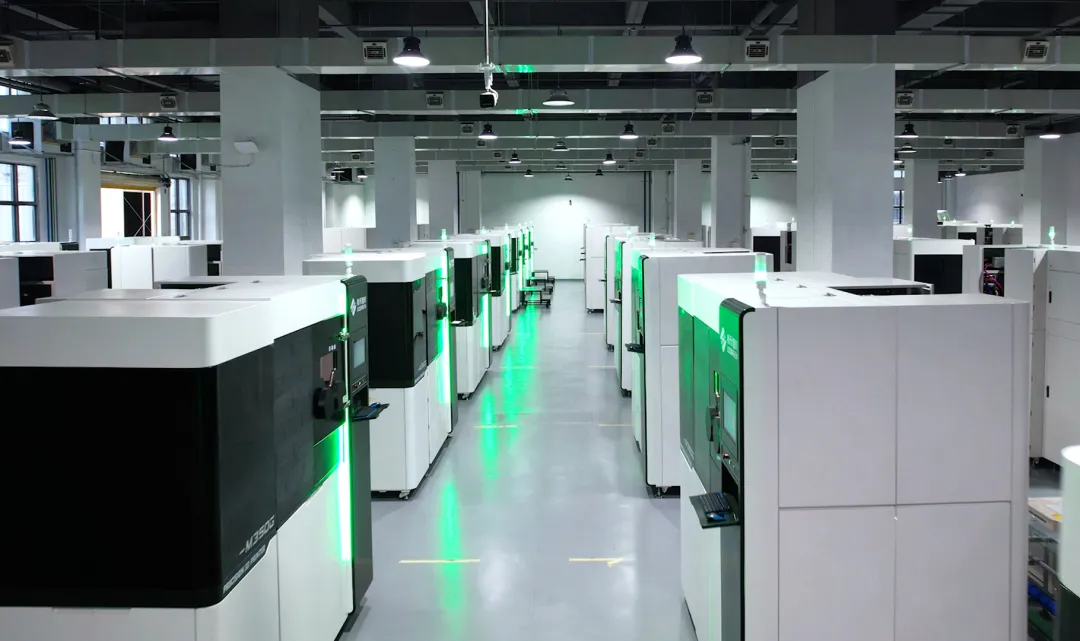
Beyond prototype development, Addireen has established series production capabilities using Green Laser metal additive manufacturing, supported by more than 100 industrial metal 3D printing systems.In one approximately 140-hour build, an XH-M350G produced more than 400 pure-copper heat sinks on a single build plate, featuring thin walls and fine fins. The XH-M350G series has accumulated more than 100,000 printing hours in total.This production experience demonstrates Addireen's ability to manufacture complex pure-copper components at scale, providing a manufacturing foundation for demanding thermal management applications, including copper cold plates.
From fine-feature fabrication to batch manufacturing, Addireen has accumulated practical experience in producing complex pure copper components and continues to develop manufacturing workflows that support production planning, process control, post-processing, and quality assurance.
4. Expanding Applications of Metal AM in Advanced Thermal Management
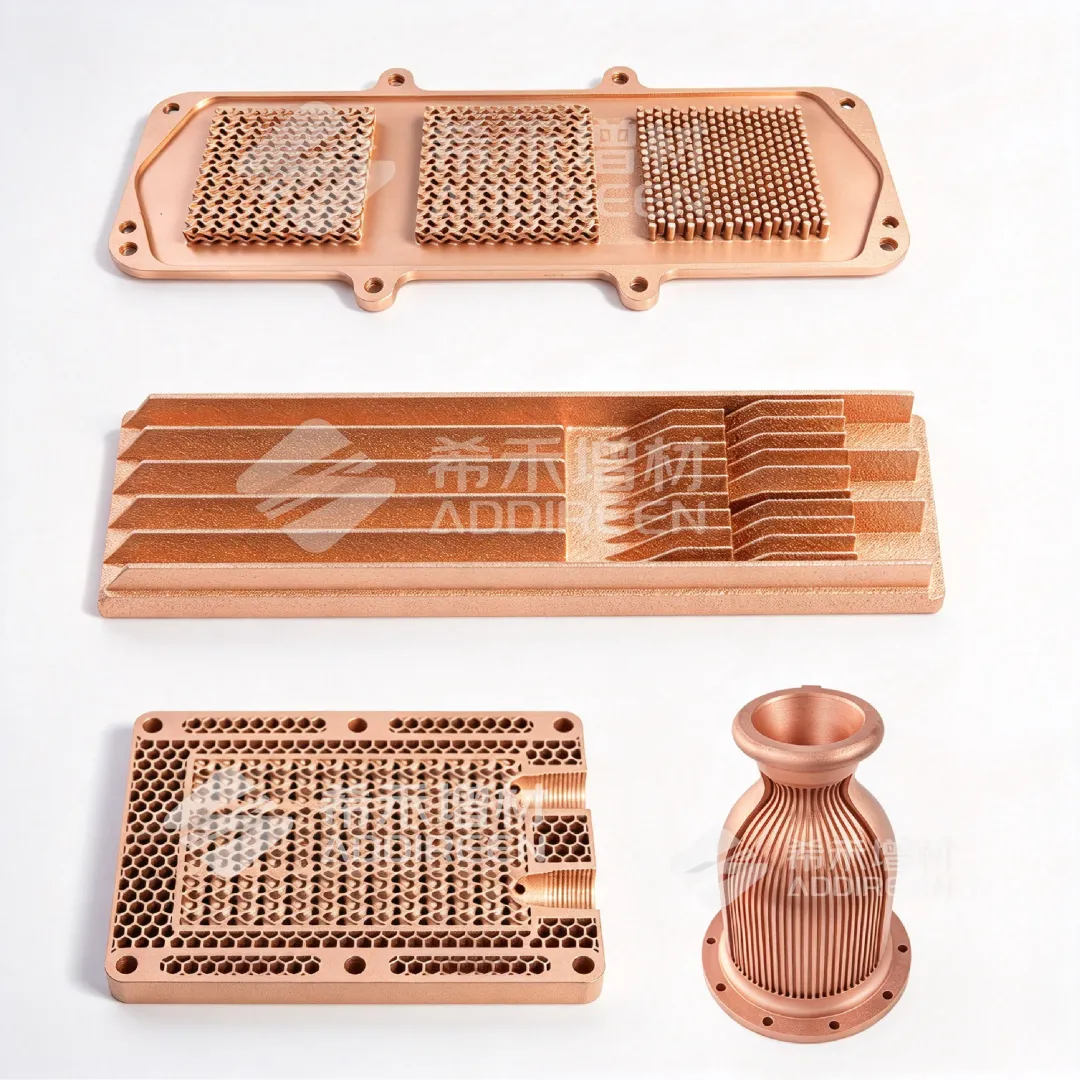
The design flexibility of Green Laser PBF enables the development of complex copper and copper alloy components for a range of thermal management applications.
Beyond liquid cold plates, Addireen's manufacturing capabilities support the development of high-performance heat exchangers, heat sinks, and integrated cooling components for data centers, power electronics, automotive, and aerospace applications.
By combining advanced structural design, material expertise, and process development, Addireen helps engineering teams translate demanding thermal management requirements into manufacturable metal components.
Looking for a Manufacturing Partner for Complex 3D Printed Cold Plates?
From TPMS structural design and fine-feature manufacturing to process development and batch production, Addireen supports the development and manufacturing of complex metal thermal management components.
For more cold-plate and heat-exchanger examples, see Advanced Thermal Management
Upload your CAD model to explore manufacturing feasibility and request a quote