[Case Study] 316L Stainless Steel Heat Exchanger with Six Internal TPMS Structures
Joint Case Study | Thermal Management and Metal Additive Manufacturing | VoxelDance handled structural design and CFD simulation; Addireen handled green-laser printing, post-processing, and inspection.
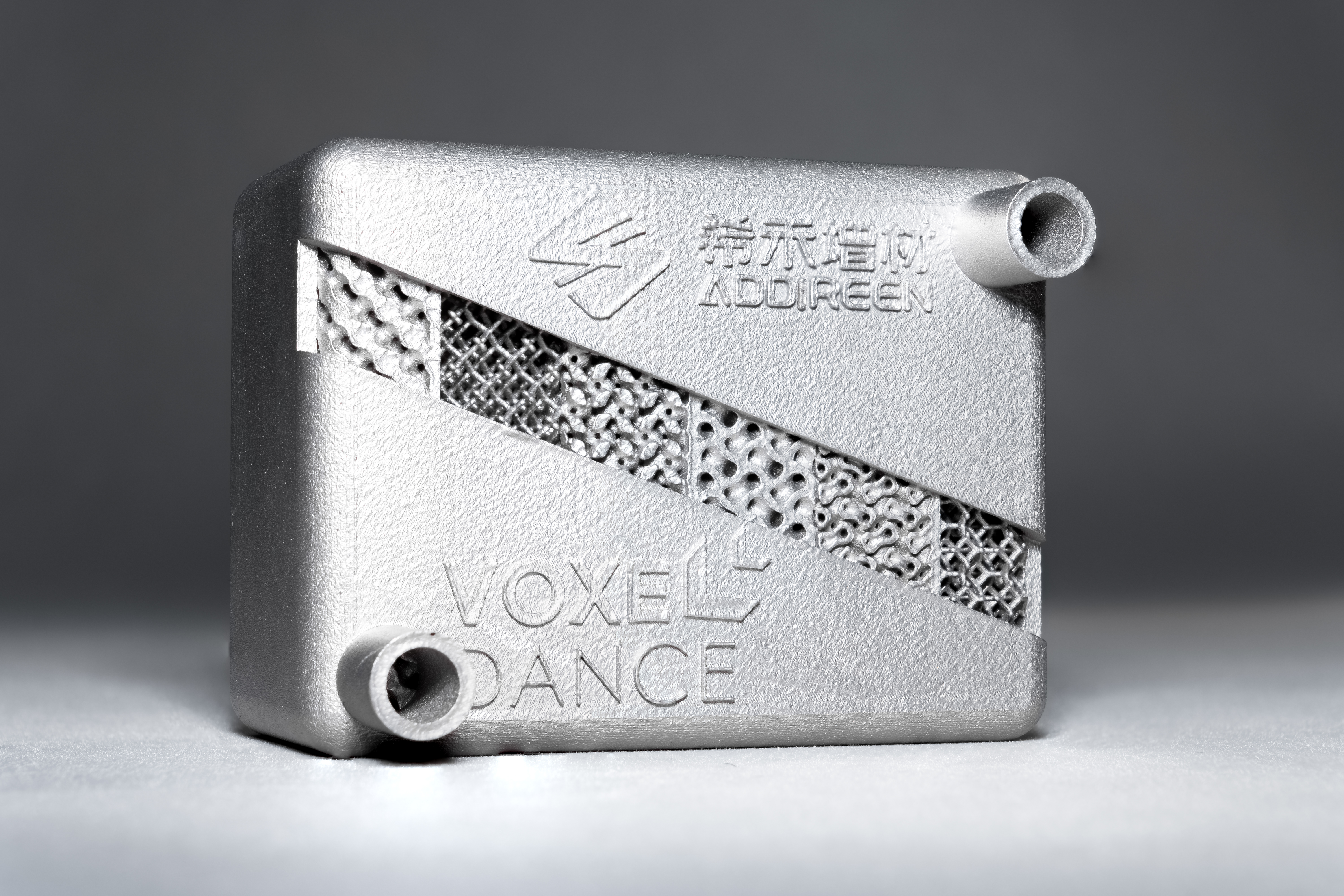
The sample integrates six internal structures, the outer shell, and fluid ports in a single part.
This 316L stainless steel heat exchanger was developed to evaluate structural design, flow simulation, and manufacturability. It integrates six internal structures. VoxelDance completed the structural design and CFD simulation, while Addireen carried out green-laser printing, post-processing, and inspection. The project focused on two questions: how the internal structures affect flow, and whether fine struts, thin walls, and continuous surfaces can be produced as designed.
1. Design Constraints for the TPMS Heat Exchanger
A compact liquid-cooled heat exchanger must balance heat-transfer area, flow distribution, and pressure loss. Increasing surface area or flow disturbance can improve heat transfer, but it may also raise flow resistance and pumping power or create local high-resistance regions. Internal structures should therefore be evaluated not only by specific surface area, but also by channel connectivity, porosity, and operating conditions.
Triply periodic minimal surface (TPMS) structures provide several geometric design variables. Continuous surfaces can create interconnected flow paths, while cell size, porosity, and wall thickness can be varied by region. Even within the same Gyroid or Diamond geometry, changes in cell size, porosity, flow rate, and boundary conditions affect heat transfer and pressure drop. Evaluation should therefore consider both thermal performance and pressure loss.
2. Project Responsibilities
VoxelDance used VoxelDance Design for implicit modeling of the six structures and analyze velocity and pressure distributions inside the sample. Addireen produced the 316L stainless steel heat exchanger by green-laser metal additive manufacturing and handled post-processing and inspection.
VoxelDance was responsible for structural design and CFD simulation. Addireen’s scope began with green-laser printing and continued through post-processing and inspection.
3. Six Internal Structures
The sample contains Diamond TPMS, Diamond Lattice, Lidinoid TPMS, Gyroid TPMS, Split-P TPMS, and Kelvin Lattice structures. The set includes both continuous surfaces and strut-based lattices, allowing comparison of passage geometry, open-flow area, structural support, and manufacturability.
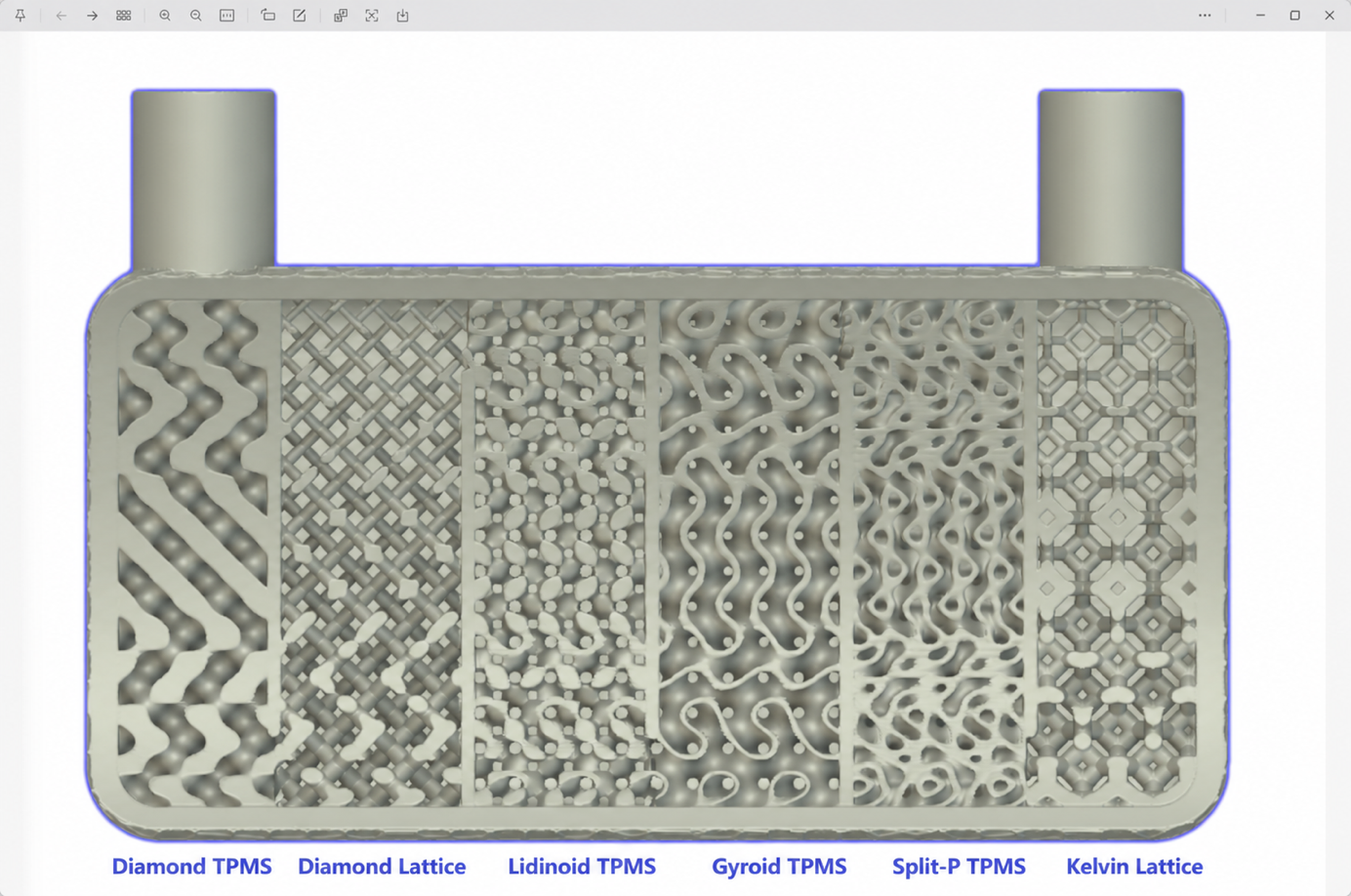
From left to right: Diamond TPMS, Diamond Lattice, Lidinoid TPMS, Gyroid TPMS, Split-P TPMS, and Kelvin Lattice.
|
Structure |
Geometry and Flow Characteristics |
Features Examined in the Sample |
|
Diamond TPMS |
Interconnected passages branch through the volume. |
Continuous porous geometry and porosity control |
|
Diamond Lattice |
An open strut topology provides both support and flow space. |
Fine-strut formation and strut connections |
|
Lidinoid TPMS |
Continuous TPMS surfaces create a large solid–fluid interface and tortuous flow paths. |
Implicit surfaces and continuous thin walls |
|
Gyroid TPMS |
Continuous surfaces without sharp corners create three-dimensional interconnected passages. |
Surface continuity and channel connectivity |
|
Split-P TPMS |
Branched passages produce more pronounced local flow redistribution. |
Complex surfaces and multi-branch passages |
|
Kelvin Lattice |
A regular strut network creates open flow paths with clear geometric relationships. |
Strut dimensions and open passages |
4. Material Considerations for 316L Stainless Steel
316L is a low-carbon, molybdenum-bearing austenitic stainless steel commonly used in process equipment and applications requiring corrosion resistance. It was selected for this heat exchanger based on fluid compatibility, temperature capability, and structural requirements—not for high intrinsic thermal conductivity. Thermal targets must therefore be addressed through heat-transfer area, flow-path design, and wall-thickness control.
316L is not resistant to every acid, salt, or high-temperature chloride environment. For marine, chemical-processing, or long-term stagnant-flow service, material compatibility should be assessed against temperature, chloride concentration, crevice conditions, and cleaning procedures.
5. Role of Green-Laser Printing in Fine-Feature Production
For comparable beam quality and optical conditions, a shorter wavelength can support a smaller focused spot. For fine struts, thin walls, and small-scale curved surfaces, this allows process parameters to be applied over a smaller interaction area. Build quality also depends on powder particle size, surface condition, layer thickness, scan strategy, and melt-pool temperature.
6. Manufacturing, Post-Processing, and Inspection by Addireen
Starting from the released model, Addireen handled green-laser printing, post-processing, and inspection. The sample combines continuous TPMS surfaces, fine-strut lattices, thin partitions, an outer shell, and fluid ports. Each geometry places different demands on local heat input and build stability.
|
Manufacturing and Inspection Item |
Project Result |
|
Material |
316L Stainless Steel |
|
Manufacturing Process |
Green-Laser LPBF |
|
Minimum Wall Thickness |
0.3 mm |
|
Surface Roughness |
Ra 5–9 μm |
|
As-Built Density |
≥99.9% |
Post-Processing and Inspection Scope
After printing, Addireen continued with post-processing and inspection. Depending on delivery requirements, production heat-exchanger projects may include depowdering and channel cleaning, dimensional inspection, surface finishing, machining, internal cleanliness checks, leak-tightness testing, pressure testing, and pressure-cycle testing.
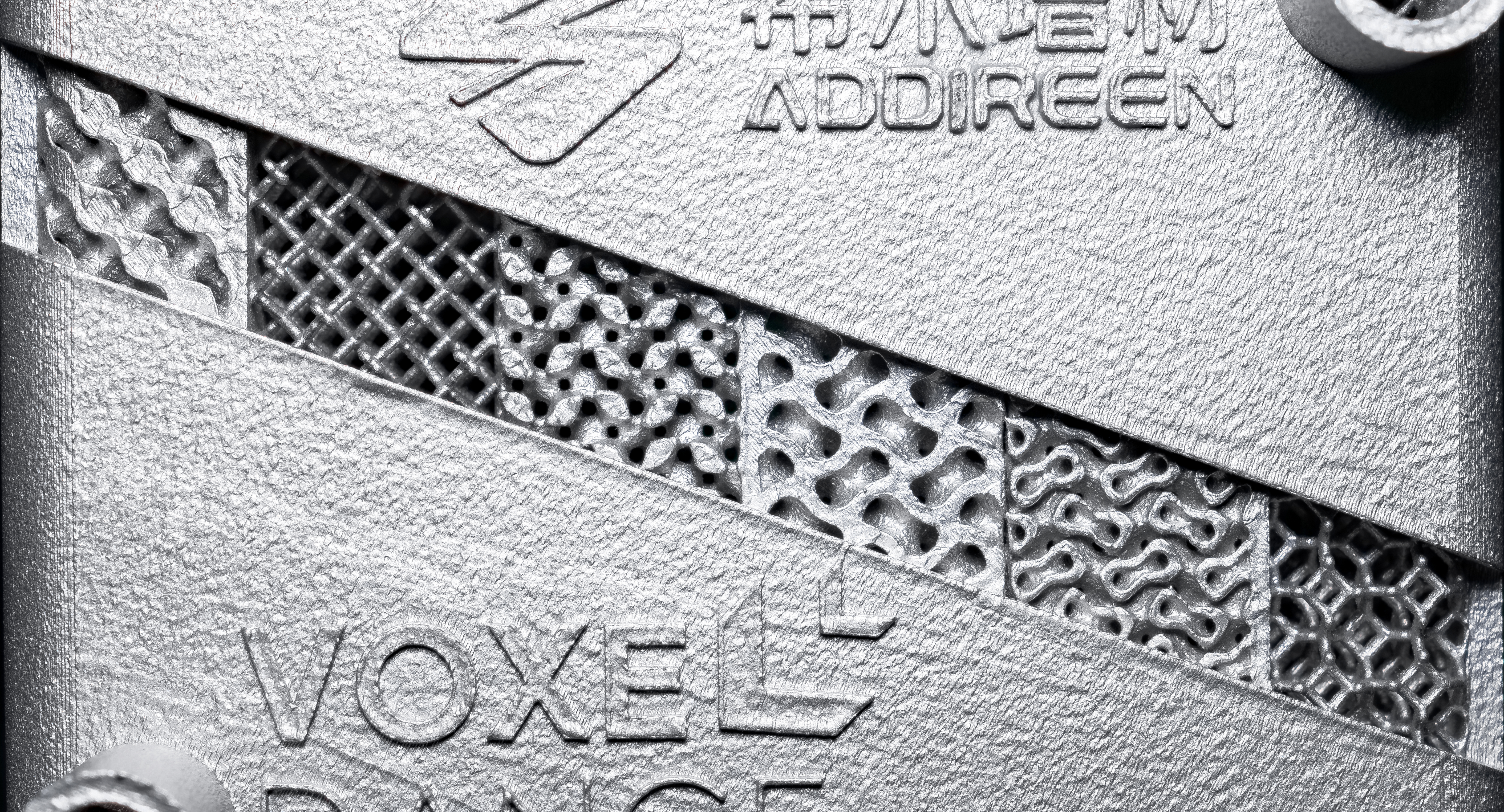
A close-up of the printed part shows the transitions between continuous surfaces, fine lattice struts, and the outer shell.
7. Potential Application Areas
This type of 316L stainless steel cooling structure can be evaluated for liquid-cooled heat exchangers, fluid manifolds, industrial-fluid temperature-control components, thermal structures for energy equipment, and cooling components for marine systems.
8. Information Required for Manufacturing Assessment
For manufacturing assessment, provide the 3D model together with thermal, flow, structural, and acceptance requirements. These inputs define the scope of material selection, printing, post-processing, and inspection.
|
Information Category |
Recommended Inputs |
|
Fluid and Material |
Working fluid, corrosiveness, material grade, and compatibility requirements |
|
Thermal Conditions |
Inlet temperature, target outlet temperature, heat load, or allowable thermal resistance |
|
Flow Conditions |
Flow rate, operating pressure, allowable pressure drop, and flow direction |
|
Structural Constraints |
Installation envelope, interfaces, minimum channel size, and no-change regions |
|
Acceptance Requirements |
Dimensions, roughness, density, cleanliness, leak tightness, and pressure requirements |
|
Delivery Requirements |
Quantity, post-processing condition, machining surfaces, and delivery schedule |
Summary
VoxelDance completed the design and CFD analysis of the six internal structures; Addireen completed green-laser printing, post-processing, and inspection of the 316L stainless steel sample. Reported results include a minimum wall thickness of 0.3 mm, a surface roughness of Ra 5–9 μm, and an as-built density of at least 99.9%. These results describe the flow and manufacturing performance of the demonstrator. Before use in a production design, thermal performance, leak tightness, pressure resistance, and pressure-cycle durability should be verified under defined heat load, fluid, pressure, and allowable pressure-drop conditions.
If you are evaluating a stainless steel heat exchanger or another 316L component, visit https://www.addireennow.com/en/stainless-steel-316l-3d-printing-service/S5SAV.html for material, process, and post-processing information.
For other metals used in thermal management, visit https://www.addireennow.com/en/industries/advanced-thermal-management/c44da.html.
If you have a 3D model and basic operating conditions, upload your files at https://www.addireennow.com/en/quote to request a manufacturing assessment and quotation.