[Case Study] AI Liquid Cooling Is Moving Toward Production.
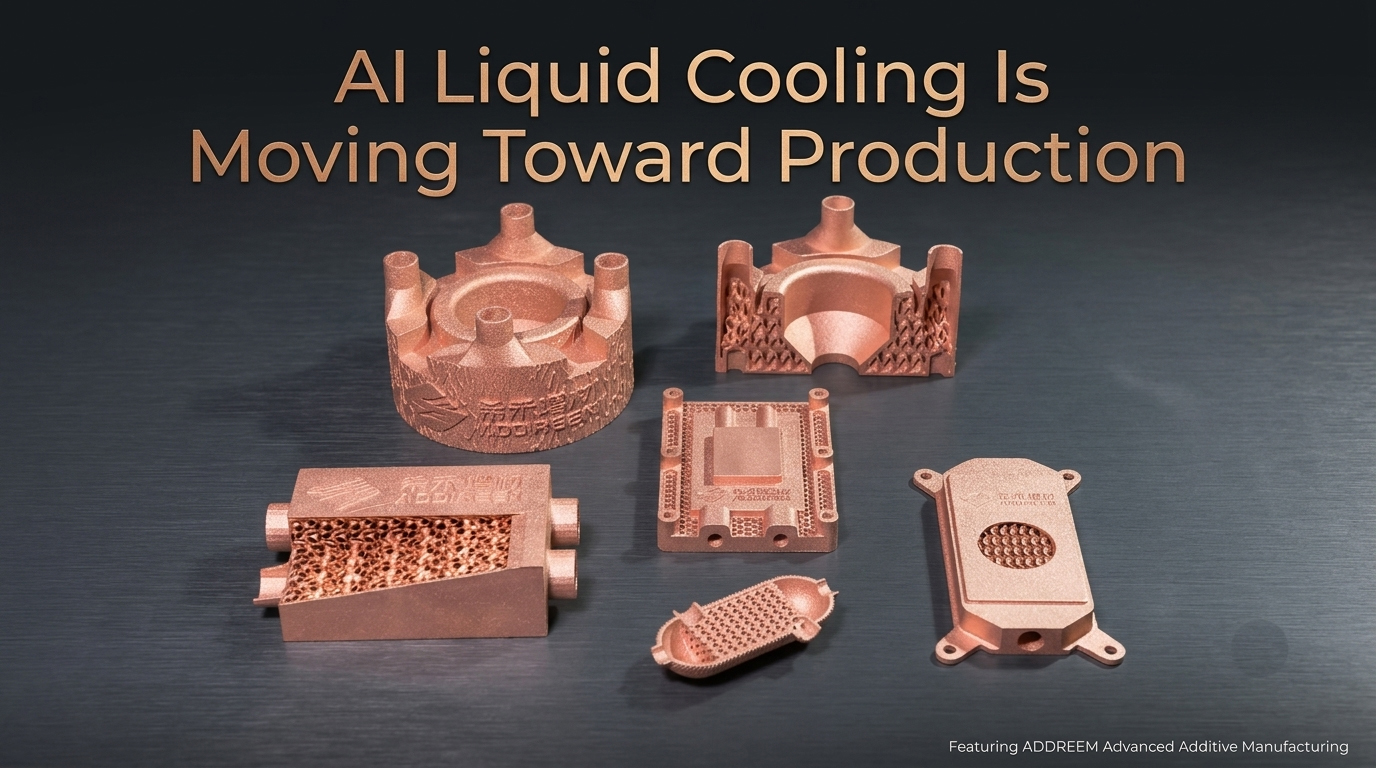
AI liquid cooling is no longer a pilot topic
AI servers are pushing more heat into smaller spaces. As rack power density rises, air cooling and conventional liquid cooling structures are being asked to do more than they were originally designed for. The issue is no longer only whether liquid cooling works. The harder question is whether key components, especially pure copper liquid cold plates and microchannel heat exchangers, can be manufactured with the precision, consistency, and throughput required for production.
Liquid cooling penetration in AI servers is projected to reach 47% in 2026, while the global data center liquid cooling market is expected to reach USD 16.5 billion. These numbers indicate a shift from engineering validation to supply-chain execution. For thermal teams, that changes the problem: performance still matters, but manufacturability, repeatability, and lead time now matter just as much.
Why pure copper cold plates are difficult to scale
Pure copper is attractive for liquid cold plates because of its high thermal conductivity, up to 400 W/(m·K), and its ability to support applications that combine thermal and electrical requirements. But copper is also difficult to process by conventional metal additive manufacturing.
At the 1,064 nm wavelength used by many infrared laser systems, pure copper absorbs less than 5% of the laser energy. Most of the energy is reflected, while the heat that is absorbed dissipates quickly because copper is highly conductive. This combination can make the melt pool unstable and increase the risk of porosity, spatter, and inconsistent fusion.
For AI liquid cooling hardware, process instability becomes a production issue. Microchannel width, height, and depth must be controlled tightly. Small deviations can change local flow resistance or create local hot spots. In server clusters, pressure drop variation across cold plates also needs to be controlled.
Conventional manufacturing methods face their own constraints. Brazed or assembled cold plates introduce joints, sealing interfaces, and process steps that add risk. Machining can produce reliable parts, but it limits internal geometry. As thermal simulation pushes toward more complex flow paths, the gap between ideal thermal design and manufacturable structure becomes harder to ignore.
What changes with green laser 3D printing
Green laser processing addresses the copper problem at the material interaction level. At 532 nm, copper absorption rises to about 40%, compared with less than 5% under 1,064 nm infrared laser irradiation. This higher absorption improves energy coupling into the powder bed and helps stabilize the melt pool.
For pure copper LPBF, that matters because it enables complex copper parts to be built with better density, conductivity, and feature control. In Addireen's reported green laser copper process, printed pure copper parts can reach 101% IACS electrical conductivity, density up to 99.9%, and stable wall thickness down to 0.1 mm.
These values are important because they connect process capability to cold plate design. In high heat flux AI cooling, the goal is not simply to print copper. The goal is to produce flow channels, thin-wall fins, and heat-transfer structures that can be repeated from prototype to batch production.
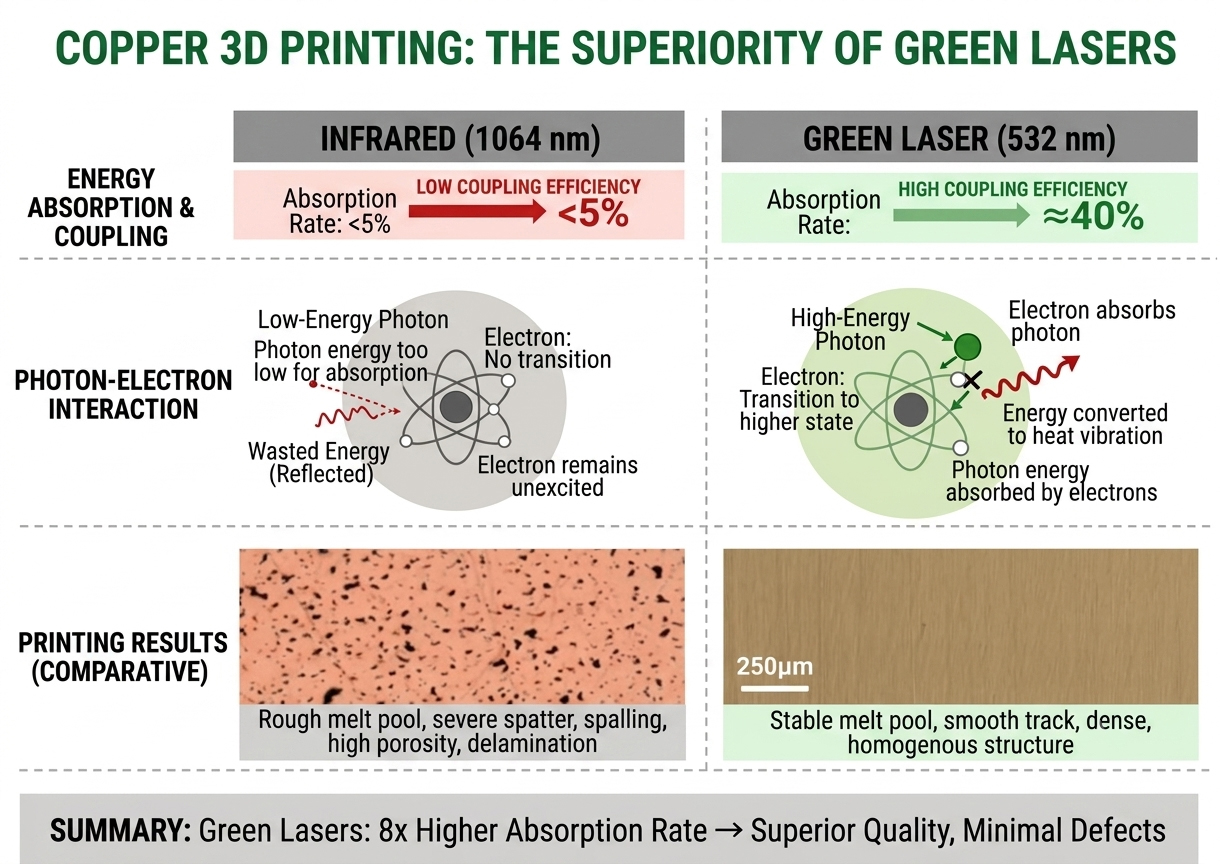
Figure 1. Green-laser processing improves copper energy absorption, helping stabilize melt-pool behavior and reduce porosity risk in pure-copper additive manufacturing.
Design freedom only matters if it can be manufactured
A major benefit of green laser 3D printing is the ability to form complex internal geometries as one continuous metal part. This can include microchannels, high-density thin-wall fins, non-planar flow paths, and TPMS-based heat exchange structures.
For thermal engineers, this changes the design workflow. Instead of simplifying the flow path to match tool access or brazing constraints, the geometry can be developed around heat flux distribution, pressure drop targets, and manufacturability limits. That makes it easier to close the gap between thermal simulation and physical hardware.
Monolithic construction also removes several common risk points. A one-piece liquid cold plate has no brazed joints inside the flow path and fewer interfaces that can become leak points. It can also reduce contact thermal resistance caused by assembled structures. The practical result is not a promise that every design will perform better automatically. It is a wider design space, provided that simulation, printing, powder removal, inspection, and testing are handled as one engineering workflow.
From sample parts to production consistency
For AI data center cooling, the real production challenge is consistency. A printed cold plate must meet dimensional targets, maintain pressure drop within the required range, pass leakage and reliability checks, and remain repeatable across batches.
This is where equipment scale and process control become relevant. Addireen's green laser platform can be positioned as part of the scale-up path for larger or higher-throughput copper thermal components. Supports the transition from process validation to more repeatable batch production, while still retaining the geometric advantages of green laser LPBF.
The production path should be viewed as a closed loop:
- Heat flux and pressure drop requirements are defined.
- Internal channel geometry is developed through thermal and flow simulation.
- Printability is reviewed against wall thickness, support strategy, powder removal, and inspection access.
- Prototype parts are printed and tested.
- Design and process parameters are adjusted.
- The validated design moves into controlled batch production.
This workflow is slower than simply printing a demonstration part, but it is the part that matters for AI infrastructure. Cooling hardware in data centers must be manufacturable, measurable, and serviceable.
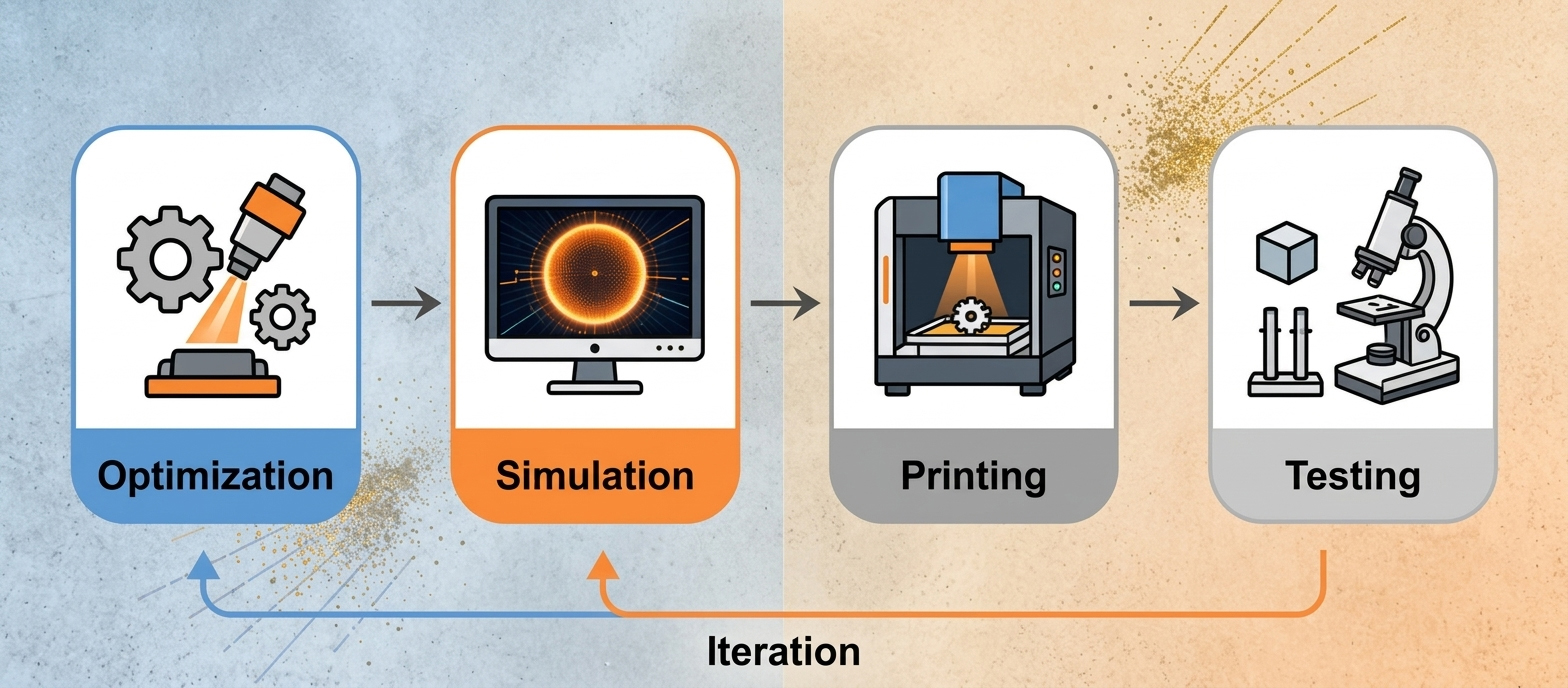
Figure 2. A closed-loop workflow connects design optimization, thermal simulation, printing and testing to shorten iteration cycles for liquid-cooling components.
Conclusion
AI liquid cooling is moving from pilot deployment to production planning. In that shift, pure copper liquid cold plates face a practical manufacturing question: can high-conductivity copper structures be produced with complex internal geometry, tight dimensional control, and repeatable batch quality?
Green laser 3D printing provides a reliable path because it improves copper laser absorption at the process level and expands what can be manufactured at the geometry level. For high heat flux AI cooling, its value is strongest when material processing, thermal design, printability review, testing, and production control are treated as one workflow.
- For engineering teams evaluating liquid-cooling components for AI data centers, the next step is to connect thermal design with manufacturable copper structures.
https://www.addireennow.com/en/industries/advanced-thermal-management/c44da - Learn more about Addireen’s green-laser copper thermal management approach in the full white paper:
https://www.addireennow.com/en/green-laser-copper-thermal-management/ad64d - Ready to evaluate a part? Upload your CAD file for an online quote:
https://www.addireennow.com/en