[Case Study] LPBF AlSi10Mg Heat Exchanger
In aerospace, electric drive units, and high-density liquid cooling systems, thermal management design faces a core trade-off between heat dissipation and component weight. Constrained by conventional machining and brazing limits, it is difficult to expand heat exchange surface areas or optimize internal micro-channels under strict mass budgets.
AlSi10Mg processed via Laser Powder Bed Fusion (LPBF) offers a viable technical pathway to overcome this lightweighting bottleneck.
1. Material Selection: From Absolute to Specific Thermal Conductivity
While pure copper offers high absolute thermal conductivity (~388 W/m·K), systems with stringent mass constraints must evaluate materials based on "specific thermal conductivity" (thermal conductivity per unit mass).
Following specific heat treatments, AlSi10Mg achieves a specific thermal conductivity index of 69.3, outperforming standard 6061T6 aluminum (61.9) and C110 copper (43.6). For projects that must balance strict mass control with complex internal channel designs, AlSi10Mg delivers a practical engineering balance.
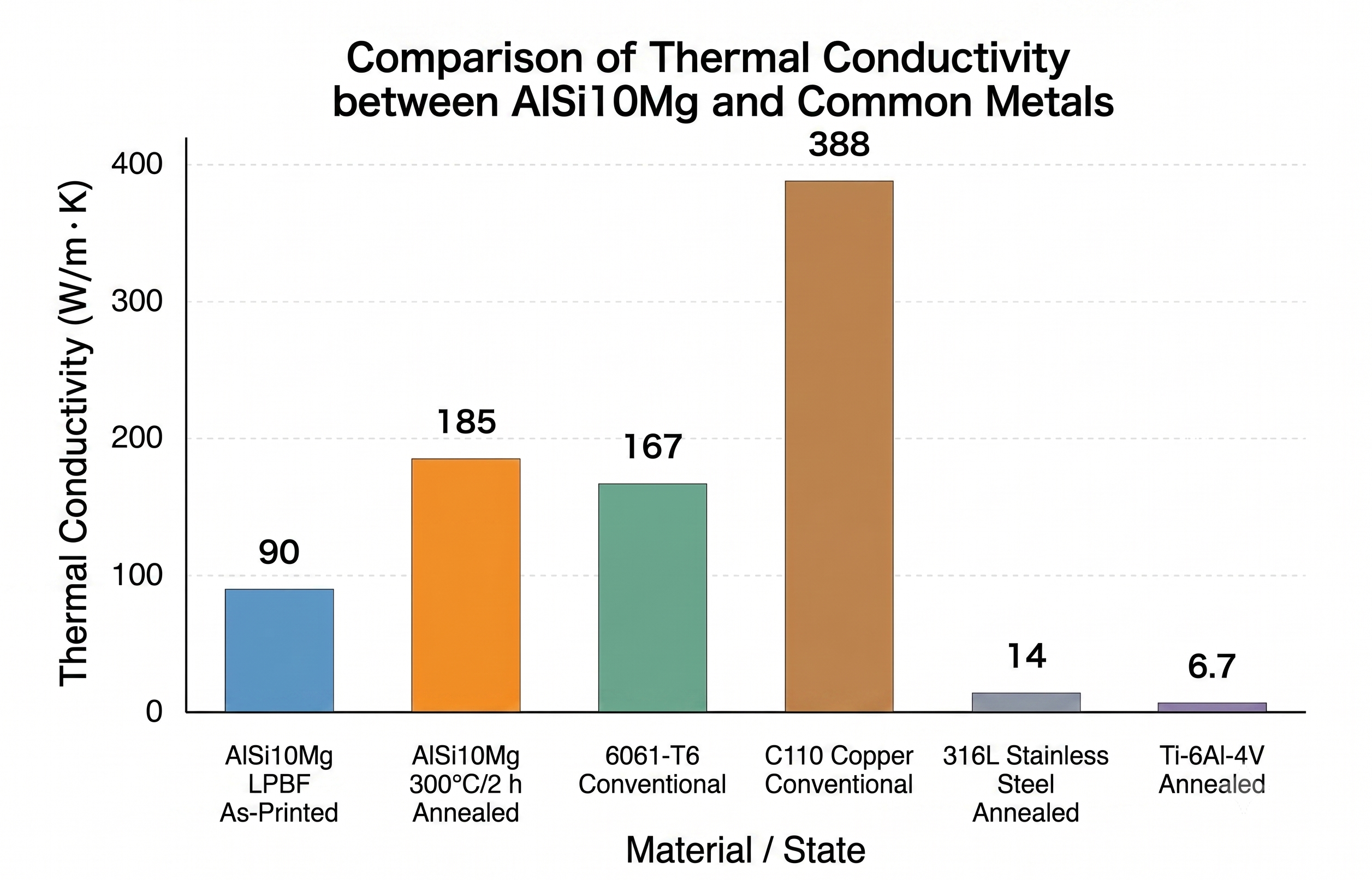
Thermal Conductivity Comparison of Common Metals
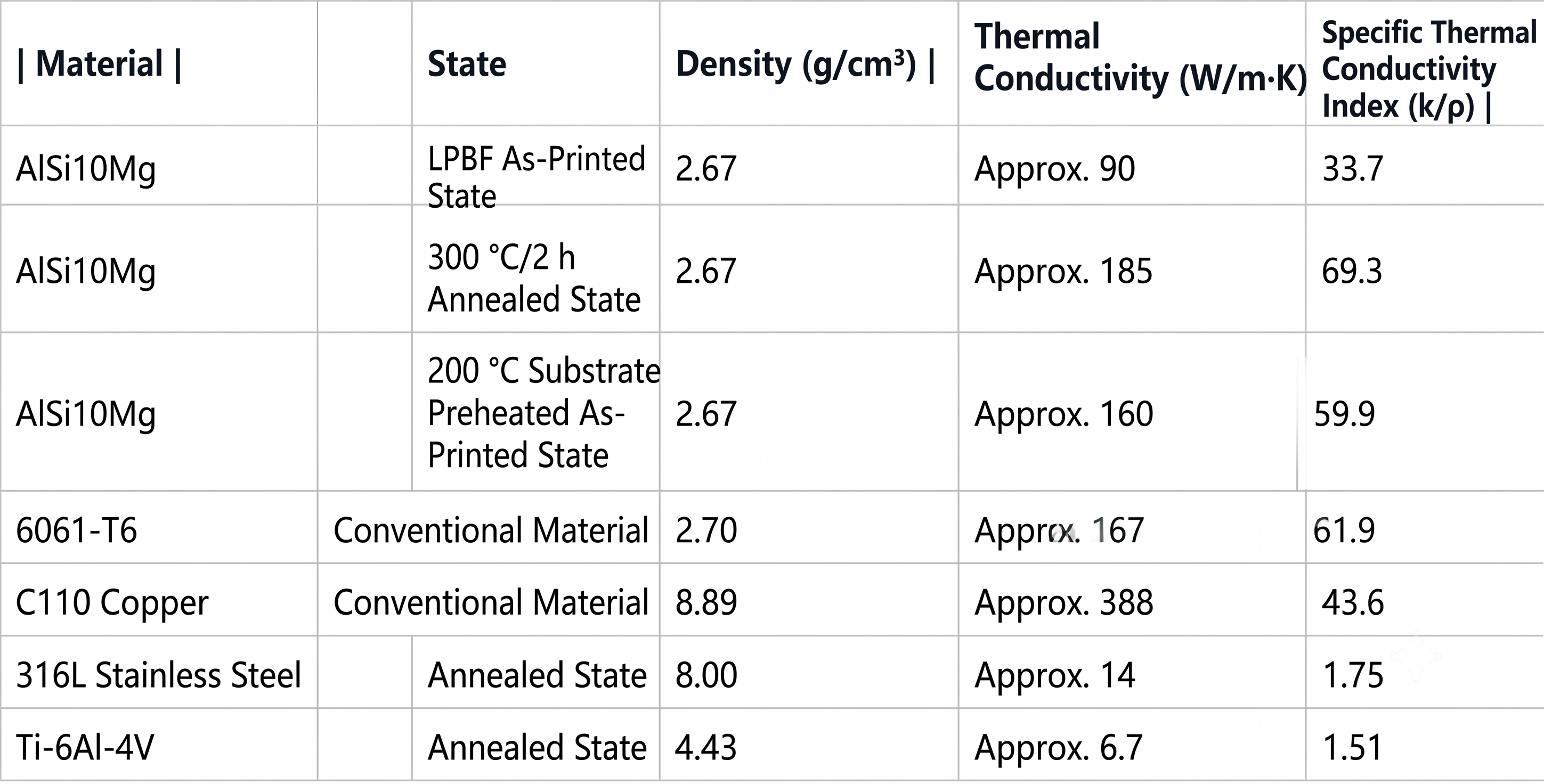
Thermal conductivity and specific thermal conductivity of common materials. When evaluated by thermal conductivity per unit mass (thermal conductivity-to-density ratio), AlSi10Mg demonstrates a distinct advantage following appropriate heat treatment.
2. Heat Exchanger Design: From Manufacturing-Constrained to Function-Driven
Conventional heat exchangers, assembled and brazed from discrete cores, fins, and manifolds, struggle to balance increased surface area with fluid pressure drop in confined spaces. LPBF-based aluminum additive manufacturing establishes the following engineering guidelines:
- Flow Distribution and Pressure Drop Decoupling: Expanding surface area within confined spaces typically causes severe pressure drops and uneven flow distribution. On the liquid side, a 1-to-6 variable-section manifold ensures uniform flow, while helical flow paths disrupt the thermal boundary layer. On the air side, aerodynamic leading edges on the fins minimize wind resistance, effectively decoupling heat transfer enhancement from pressure drop penalties.
- Thermo-Mechanical Structural Reinforcement: Heat exchangers in high-pressure systems are susceptible to deformation. Leveraging Design for Additive Manufacturing (DfAM), high-density conformal fins and external reinforcing ribs are integrated to form a 3D spatial truss network. These internal thin-walled structures serve not only as thermal conductors but also as a highly rigid mechanical skeleton.
- "Zero Leakage" Barrier: Conventional braze joints are prone to fluid leakage under fatigue. 3D printing consolidates the manifolds, ports, and heat exchange core into a single monolithic structure. This eliminates assembly tolerances and brazing thermal stresses, effectively mitigating high-pressure leakage risks.
- Powder Removal Constraints: Internal micro-channels are susceptible to un-melted metal powder retention, which can increase flow resistance or cause physical blockages. Teardrop-shaped cross-sections are implemented to enable support-free fabrication of internal channels. Furthermore, channel widths (1.5-2 mm) are strictly proportioned to the inlet/outlet diameters (6 mm ) to ensure complete and smooth powder extraction.
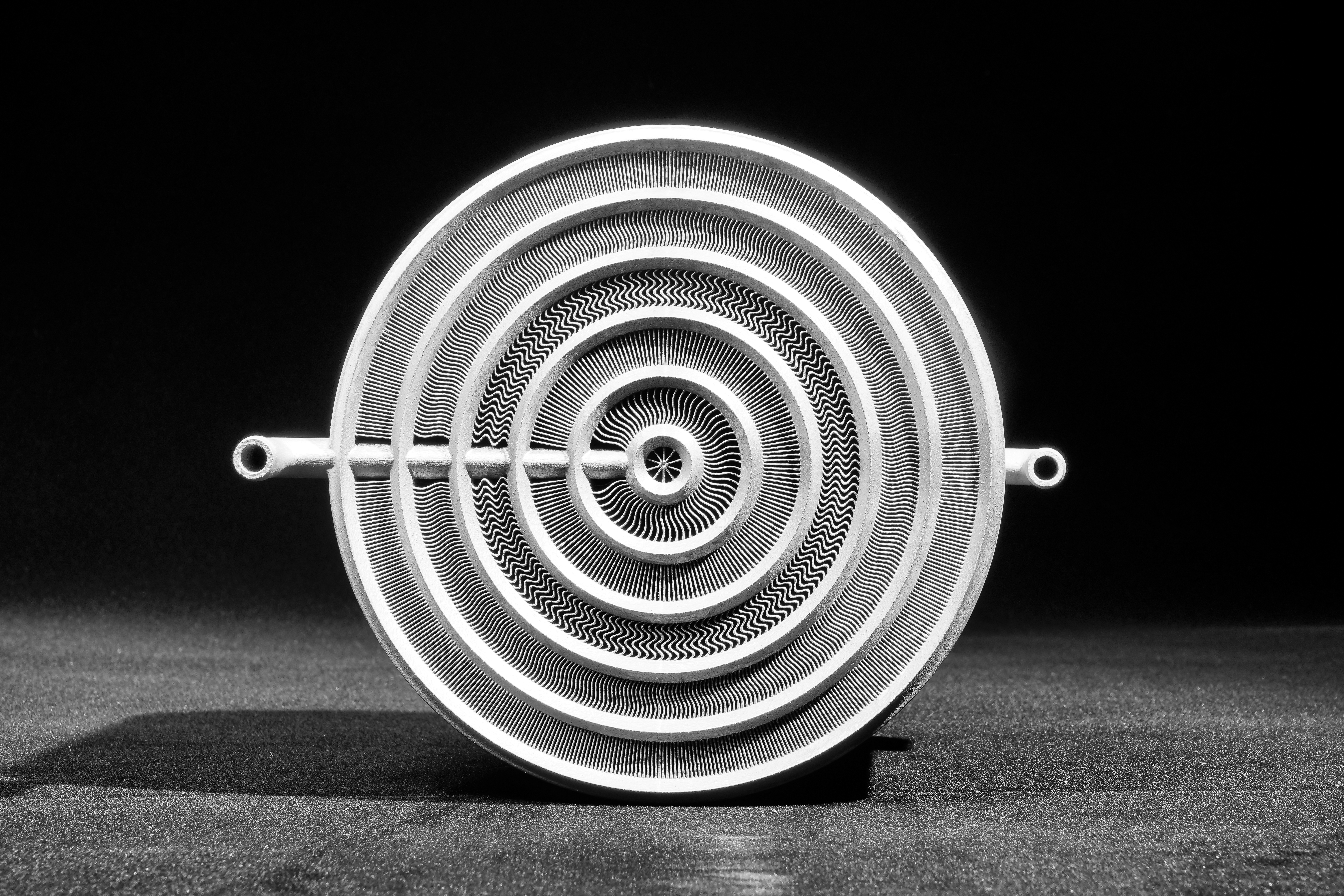
LPBF AlSi10Mg Heat Exchanger
3. Full Lifecycle Benefits: Accelerated R&D and Reduced TCO
Evaluating the commercial viability of additive heat exchangers requires shifting focus from unit manufacturing costs to a full lifecycle perspective:
- Compressed R&D Cycles: Conventional complex heat exchanger development relies on tooling fabrication and brazing fixture calibration, typically requiring 12 to 16 weeks from design to delivery. LPBFʼs tooling free nature translates CAD data directly into physical parts, compressing prototype iterations and product validation to just a few weeks.
- Supply Chain Consolidation: Monolithic fabrication consolidates discrete components (e.g., end caps, manifolds, fins) into a consolidate part. This mitigates the hidden costs associated with warehousing and multi-vendor management. Additionally, eliminating braze joint fatigue risks from conventional assemblies lowers the probability of long-term maintenance.
4. The AddireenNow Advantage
Transitioning from theoretical design to physical delivery requires rigorous manufacturability validation. AddireenNow is built to accelerate your hardware iterations by combining our digital manufacturing platform with expert application engineering. We provide:
- Engineering Assessment & DfAM: Comprehensive 3D model manufacturability checks and objective material/cost comparative analysis prior to printing.
- Streamlined Procurement: Secure CAD uploads with rapid, transparent quoting.
- Optimized Thermal Portfolio: Fully validated LPBF parameters for AlSi10Mg, Al 6061, pure copper, copper alloys and 316L Stainless Steel.
- End-to-End Execution: Predictable lead times and strict quality control, ensuring a seamless transition from initial prototyping to mid-volume production.
If your team is developing next-generation lightweight thermal management systems, contact us to initiate a technical review for tailored process evaluations and material selection recommendations.
- Email: info@addireen.com
- Metal 3D Printing Platform: https://www.addireennow.com