[Case Study] Redesigning High-Pressure Hydraulic Manifolds with AlSi10Mg LPBF
High-pressure fluid system design often requires tradeoffs among flow resistance, weight, and sealing. Due to their complex internal networks, hydraulic manifolds are a standard application for additive manufacturing.
Conventional machining and casting have physical limitations that prevent theoretical fluid optimizations from being fully realized during production. This review outlines the engineering theory for transitioning an AlSi10Mg hydraulic manifold to a monolithic Laser Powder Bed Fusion (LPBF) build. The core approach: replacing traditional cross-drilled holes with continuous, three-dimensional AM flow channels.
Engineering Compromises in Machining: Cross-Drilled Holes and Leakage Risks
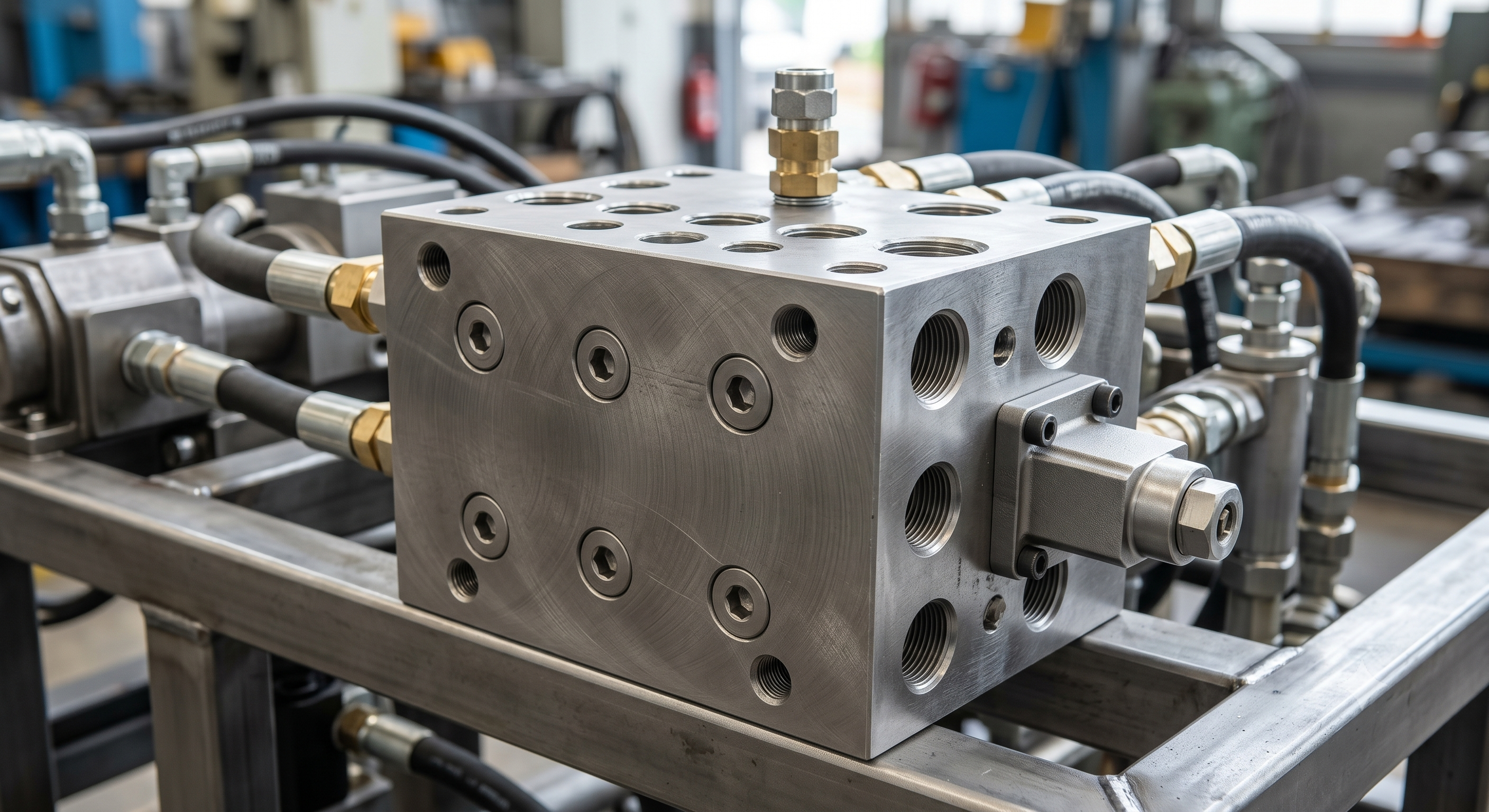
Conventional hydraulic manifolds are typically machined from solid metal blocks, relying on multi-axis drilling for internal channels. This "Manhattan-style" network of perpendicular intersections introduces several inherent system-level limitations:
- Pressure Drop and Cavitation Risks: Right-angle intersections create dead zones and flow separation, causing significant localized pressure drops that increase the power load on hydraulic pumps. Over time, these sharp turns are also highly susceptible to cavitation damage.
- Leakage Risks from Seals: To plug the construction holes required by the drilling process, a single manifold often requires over 10 threaded plugs and O-rings. Under high-frequency vibration and pressure pulsation, each assembly point becomes a potential source of fatigue-induced leakage.
- Excess Weight and Material Redundancy: Constrained by tool clearance and machining paths, the manifold must retain a large amount of non-load- bearing material. The resulting bulk and excess weight restrict its viability in mobile equipment or lightweight applications.
Hydraulic manifold with conventional manufacturing
Engineering Data from Monolithic LPBF Builds
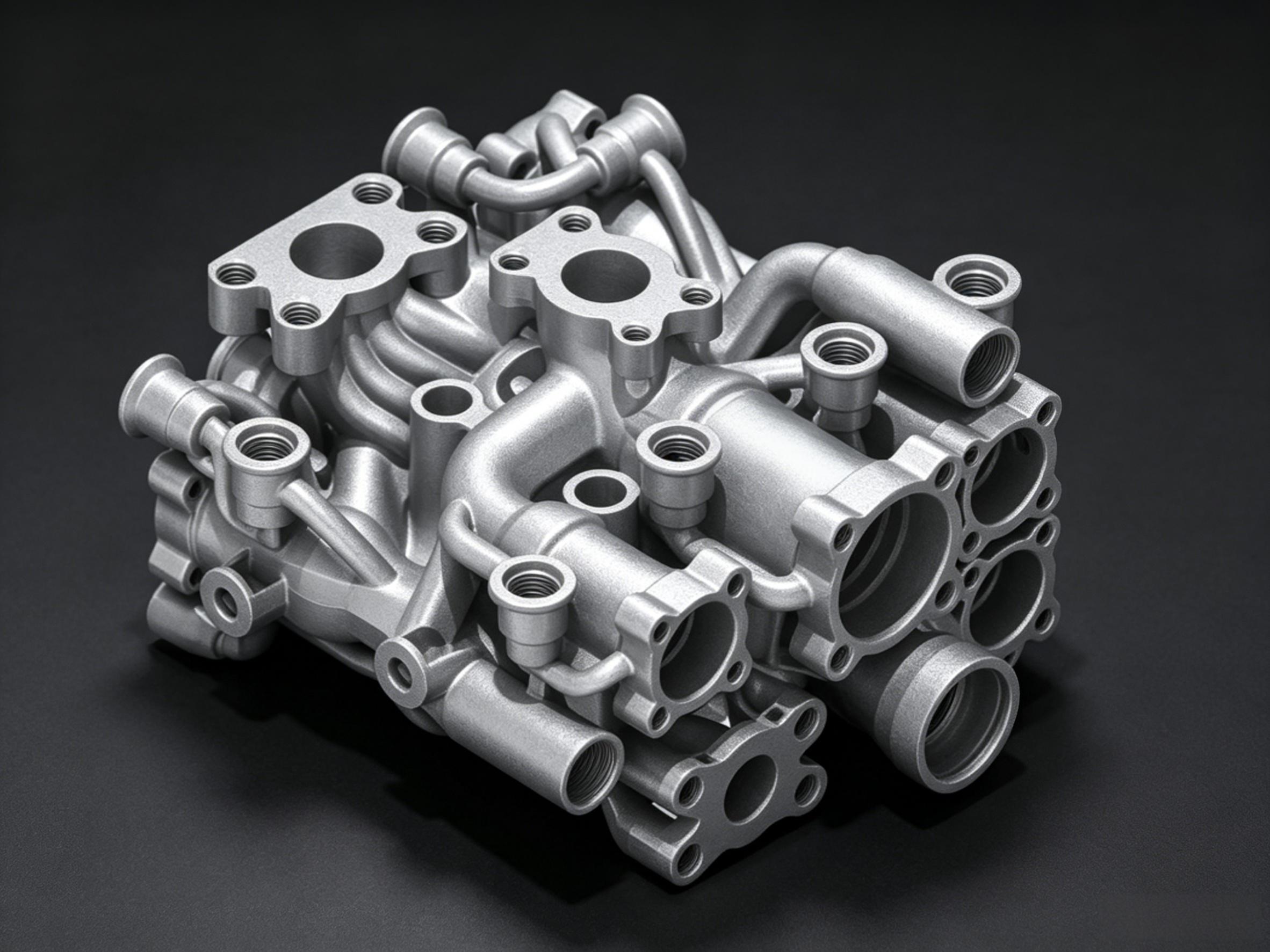
The LPBF process eliminates tool clearance constraints, allowing internal fluid networks and external load-bearing structures to be designed independently in three dimensions. Supported by CFD (Computational Fluid Dynamics) , the redesigned manifolds yield the following metrics:
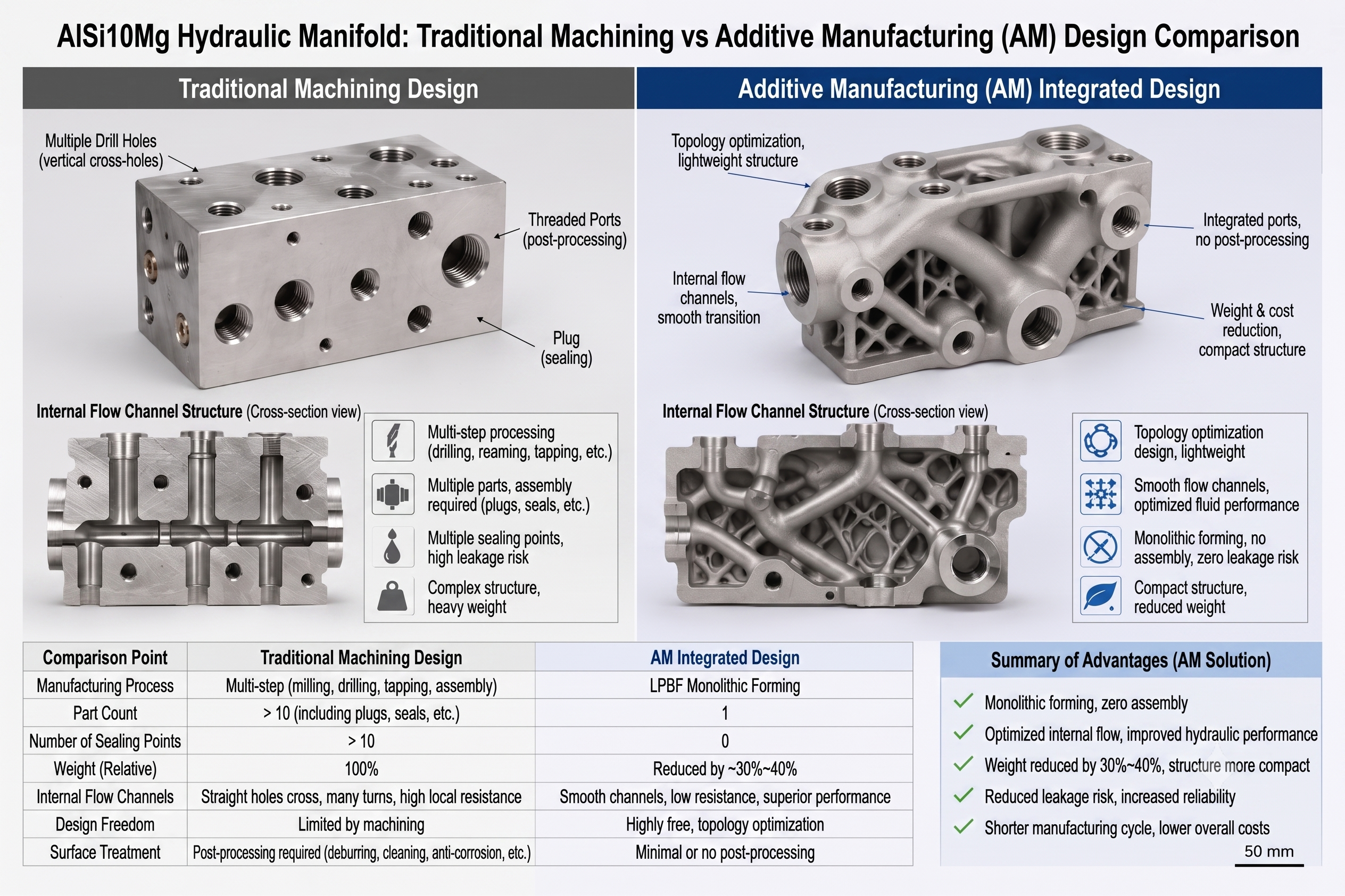
- Part Consolidation and Leak Prevention: Monolithic builds eliminate all drilling and plugging operations. The part count is reduced from over 10 to exactly 1, removing assembly sealing points. This physical restructuring removes leakage pathways caused by O-ring degradation or loose plugs, directly extending the system's Mean Time Between Failures (MTBF).
- Increased Fluid Efficiency: Flow channels are reconfigured from intersecting blind holes into continuous three-dimensional curves, largely eliminating junction turbulence. According to published industry benchmarks for manifold redesigns, the initial AM topology optimization alone can improve flow efficiency by up to 60%.
- Mass Reduction and Volume Compression: Topology optimization allows for the precise removal of non-load-bearing material. In typical industry leading case studies, overall volume can be reduced by up to 79%. Even when switching to a denser material like 316L stainless steel to accommodate extreme high-pressure conditions, the net mass reduction routinely reaches 37%.
LPBF Hydraulic Manifold
Design Comparison: Traditional vs. AM Hydraulic Manifolds. LPBF enables the redesign of cross-drilled channels into continuous, smooth fluid pathways, thereby reducing weight, pressure drop, and leakage risks.
Conclusion
Eliminating redundant seals, smoothing internal channels, reducing structural dead weight, and meeting high-pressure fatigue standards. The engineering data confirms that AlSi10Mg LPBF is a practical technical path for resolving spatial constraints and leakage risks in hydraulic control.
Manufacturing Execution: From Optimized CAD to Finished Part
Theoretical optimization does not equal engineering reality. For high-pressure hydraulic manifolds, the true manufacturing challenges lie in sealing interface precision and complete powder evacuation from internal channels—any residual metal powder will cause damage to hydraulic pumps.
This is exactly why AddireenNow enforces end-to-end manufacturing. We do not just provide basic AlSi10Mg printing; we manage the complete production workflow for lightweight topologies and thermal components. Drawing on our Green Laser LPBF expertise with intricate micro-channels and thin-wall structures, we integrate powder evacuation strategies and post-machining right from the initial DFM stage.
We refuse to ship raw, unusable prints. We deliver ready-to-use industrial components that meet strict assembly standards. If your R&D or university team is evaluating custom hydraulic manifolds or heat exchangers, submit your CAD files for a comprehensive manufacturing review.
- www.addireennow.com