[Case Study] Addireen R&D Director Co-Authors Nature Paper on Ultra-High-Temperature Tantalum Alloys
A new paper titled "Ductile alloys offering 100 MPa tensile strength at 2,400 °C" was recently published in Nature. Dr. Mintao Xue, who earned his Ph.D. in Materials Science from Xi'an Jiaotong University and serves as the Director of Materials R&D at Addireen, is the lead author of the study.
Fig. 1: Screenshot of the Nature publication.
The Material Bottleneck: High Heat vs. Room-Temperature Formability
Designing structural metals for use above 2,000°C comes with a well-known engineering trade-off. Usually, engineers must balance strength at extreme temperatures with ductility and thermal stability. Materials built to survive severe thermomechanical loads tend to be highly brittle, making it difficult to shape them into complex parts at room temperature.
Dr. Xue's research addresses this issue by presenting a different approach to tantalum-based alloy design. The paper details a boron-mediated in-situ oxidation reaction. This method introduces a dense and uniform distribution of HfO₂ nanoparticles, which are coated by boron atoms, directly inside the tantalum alloy grain interior (B-ODS Ta-12W-1Re).
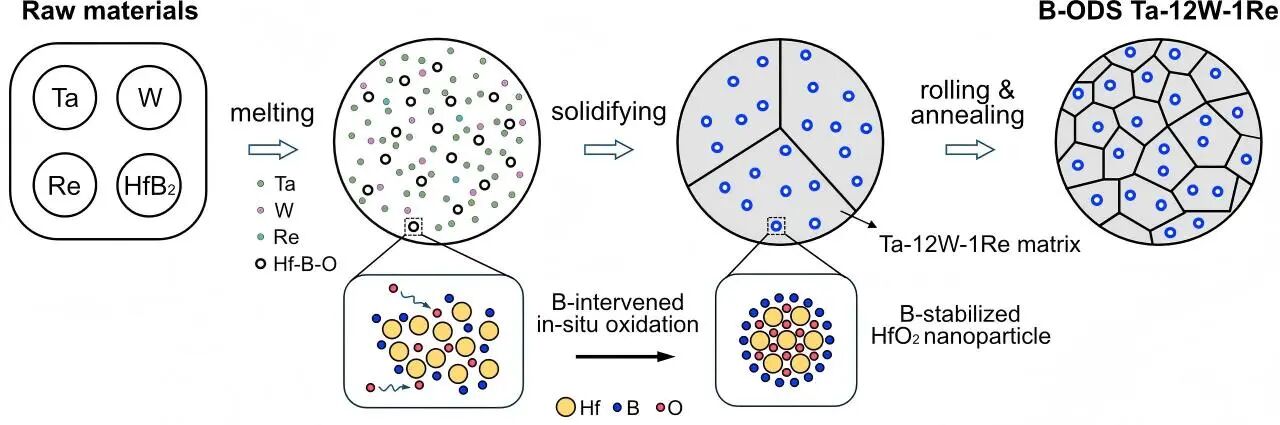
Fig. 2: Schematic of the boron-mediated in-situ oxidation reaction, introducing novel HfO₂ nanoparticles encapsulated by boron atoms within the tantalum alloy matrix.
Measured Performance
The mechanical testing data shows a clear shift compared to existing options. Specifically, the tested tantalum-based alloy maintains a tensile yield strength of 100 MPa at 2,400°C. When plotted against standard refractory alloys and newer refractory multi-principal element alloys, it shows a distinct ability to carry loads in extreme heat while remaining formable at room temperature.
This specific combination of properties points to practical uses in demanding sectors, including aerospace structures, hypersonic vehicles, and advanced propulsion systems.
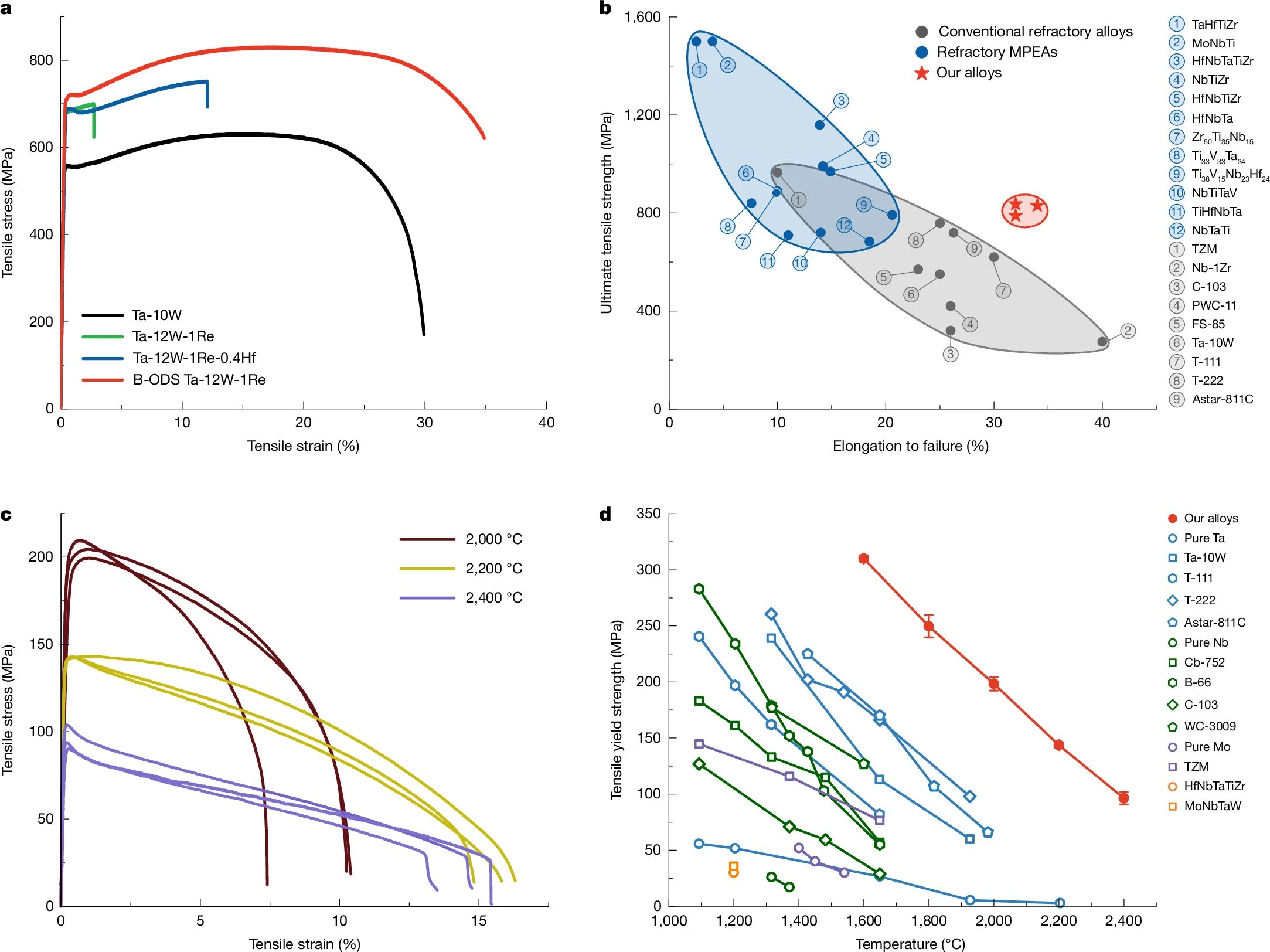
Fig. 3: Tensile properties of the B-ODS tantalum alloy. (a–b) The alloy shows a strong combination of strength and ductility at room temperature. (c–d) Performance across the 2,000–2,400°C range, indicating superior yield strength compared to conventional and emerging refractory alloys.
From Materials Research to Industrial Printing
At Addireen, our view is straightforward: pushing metal additive manufacturing into high-end applications requires foundational material innovation.
Dr. Xue's focus on refractory metals directly supports what we do every day: combining hard-to-process metals with green-laser powder bed fusion technology. Our engineering teams are working to control the entire manufacturing chain, starting from alloy design and powder properties, all the way through to process parameters and final microstructural checks.
By linking this level of metallurgical research with our printing platforms, we are working to provide reliable, ready-to-use metal components for thermal management, aerospace, and high-end equipment engineering.