[Technology] AlSi10Mg in 3D Printing: The Overlooked Specific Thermal Conductivity
When evaluating AM materials for thermal management, engineers often look at the highest absolute thermal conductivity. That points straight to pure copper. But if our system has strict weight limits, absolute thermal conductivity is the wrong metric. For weight-critical thermal scenarios, heat-treated LPBF AlSi10Mg outperforms pure copper by delivering a higher mass-normalized thermal conductivity, unlocking true lightweight cooling designs.
Microstructure control matters more than the raw thermal numbers on a datasheet.
The Metric That Drives Lightweight Design
Absolute thermal conductivity (k) ignores weight. In aerospace, robotics, or EV powertrains, weight is a hard constraint. The number that actually matters here is Specific Thermal Conductivity (k/ρ)—how much heat you can move per unit of density.
Figure 1: Specific Thermal Conductivity (k/ρ) comparison. Properly heat-treated LPBF AlSi10Mg outperforms both pure copper and 6061-T6 aluminum in weight-critical thermal applications.
As the data shows, heat-treated LPBF AlSi10Mg has the highest k/ρ index. If you are building heat exchangers for weight-sensitive applications, this is the metric that should drive your design.
The "As-Printed" Trap
Many teams make the mistake of testing "as-printed" AlSi10Mg for thermal performance. The rapid melting and cooling of the LPBF process creates a very specific microstructure:
- A nanoscale silicon network at the grain boundaries.
- High dislocation density from thermal stress.
- A supersaturated solid solution of silicon in aluminum.
These microstructural defects scatter phonons and electrons. As a result, the thermal conductivity of as-printed parts sits around 90 W/m·K (a k/ρ index of just 33.7). The fine microstructure that makes the part strong also bottlenecks its ability to transfer heat. Specifying as-printed AlSi10Mg for a thermal part guarantees underperformance.
Why Heat Treatment is Mandatory
To make AlSi10Mg work for thermal management, heat treatment is not optional.
Annealing the part (e.g., at 300°C for 2 hours) shifts the microstructure: the silicon network coarsens, the solid solution breaks down, and dislocation density drops. This clears the path for electrons.
The result? Thermal conductivity jumps to ~185 W/m·K. We do lose about 10–15% of the ultimate tensile strength, but for cold plates and heat exchangers, this is an easily acceptable trade-off.
The engineering framework is simple:
- Need max strength? Stick to as-printed or T6-aged.
- Need max cooling? Specify annealed.
Typical melt pool microstructure of LPBF-built AlSi10Mg. The rapid melting and solidification process results in an overlapping melt pool structure.
Cellular structure of LPBF AlSi10Mg and its evolution after heat treatment. Heat treatment induces the coarsening of the Si-rich network and reduces defects, thereby improving thermal conductivity and ductility.
The Topology Optimization Edge
Complex fluid structures—like conformal cooling channels, micro-feature fins, and lattice structures—are where LPBF superior CNC machining in manufacturing complex geometries. Pair these complex geometries with annealed AlSi10Mg, and you achieve surface area-to-volume ratios that conventional manufacturing simply cannot replicate at the same weight.
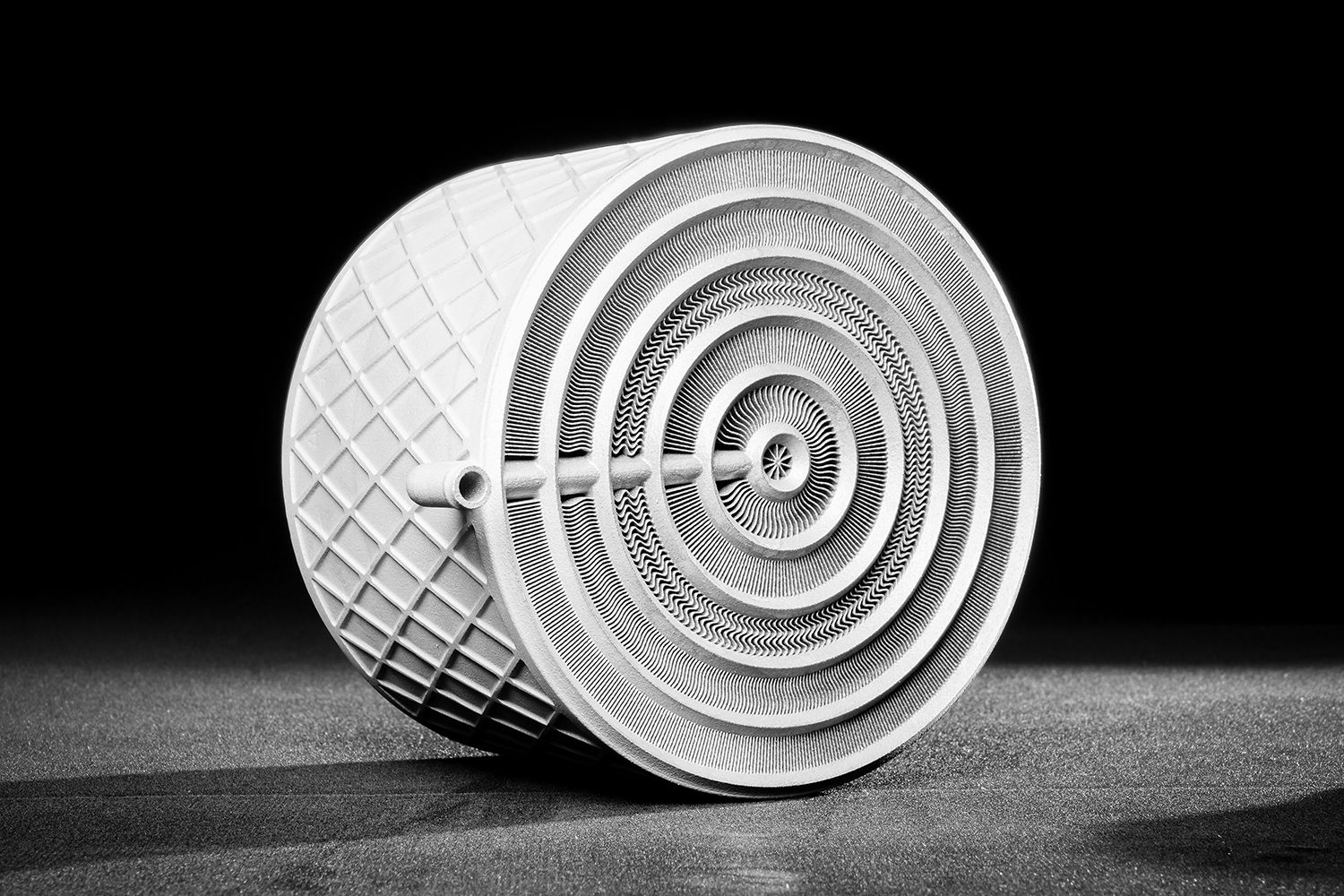
Figure 2: A topology-optimized AlSi10Mg heat exchanger. LPBF enables complex internal fluid channels and lattice structures that are impossible to machine, maximizing the surface-area-to-volume ratio without adding weight.
AlSi10Mg vs. Pure Copper: How to Choose
It is not about which material is better; it depends entirely on your boundary conditions.
Choose AlSi10Mg when:
- Weight is your primary constraint.
- Heat flux is moderate.
- You need complex, lightweight internal geometries.
Choose Pure Copper (Green Laser AM) when:
- Localized heat flux exceeds aluminum's physical limits.
- You need absolute maximum conductivity (~400 W/m·K) and weight is secondary.
- Typical applications: AI data center cold plates or high-power electronics.
Addireen prints both. The right choice starts with your heat flux map and mass budget, not a blind material preference.
If your thermal design is hitting a wall, upload your CAD for a manufacturability review. Our engineers will help you lock in the right material and heat treatment from day one.